
You walk into your garage and see a shimmering puddle reflecting off the concrete. Your heart sinks. You've probably heard the horror stories of tanks bursting and flooding entire homes. It’s stressful to see water pooling, and it's natural to worry about a massive bill or a high-pressure sales pitch for a new system. You're likely staring at the mess and weighing a water heater leaking from bottom repair or replace decision right now. We understand that frustration. Most homeowners just want their hot water back without being sold a unit they don't actually need.
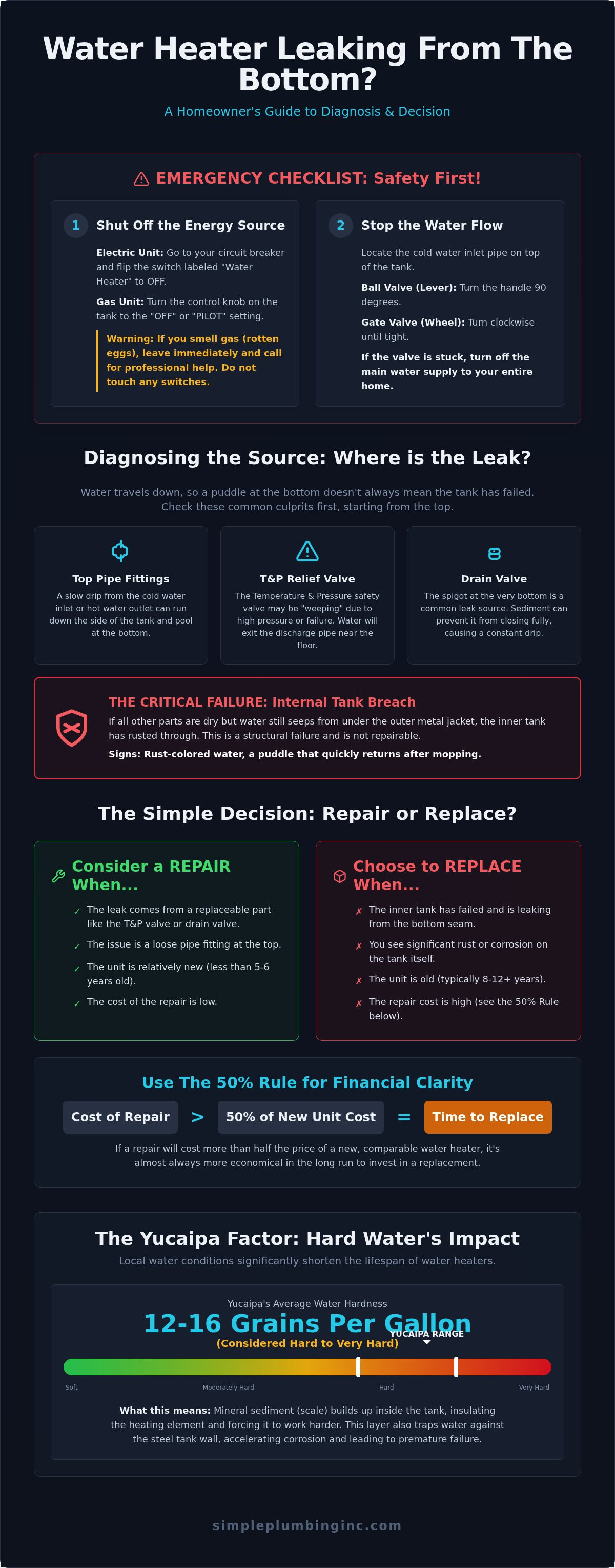
The good news is that a puddle isn't always a death sentence for your equipment. Sometimes, a simple valve adjustment or a small part replacement is all it takes to get things dry again. We'll help you identify the exact source of the leak and determine if a repair is a safe, long-term option. We'll look at how Yucaipa’s water hardness, which averages 12 to 16 grains per gallon, affects your tank’s lifespan. You'll learn how to spot the difference between a minor drip and a compromised inner tank so you can make an honest assessment of your next steps.
Key Takeaways
- Safety first: learn how to properly shut off your water supply and avoid electrical hazards when you spot a pooling leak.
- Tracing the source: discover how to determine if your water heater leaking from bottom repair or replace situation is a simple valve fix or a cracked tank.
- The 50% Rule: understand how to weigh the cost of a repair against the age of your unit to make the most financial sense for your home.
- The Yucaipa factor: see how local hard water and sediment buildup can accelerate tank damage and influence your decision to upgrade.
- Honest assessment: learn about the Simple Plumbing Inc "No-Fluff" guarantee and what to expect during a professional leak detection visit.
Immediate Actions: What to Do When You Spot a Leak
Finding a puddle under your tank is a stressful moment. Your first instinct might be to grab a mop, but safety comes first. If you have an electric unit, do not step into the water. Standing water near electrical components creates a serious shock hazard. Take a deep breath and focus on stopping the flow and the heat before you worry about the mess. This quick response protects your home from secondary damage while you figure out if a water heater leaking from bottom repair or replace is your next step.
Shutting Off the Energy Source
You need to disable the heating source immediately. For electric models, go to your home’s main circuit breaker panel. Look for the switch labeled "Water Heater" and flip it to the "Off" position. This prevents the heating elements from burning out if the tank drains. For gas models, locate the control knob on the front of the tank. Turn the dial to the "Off" or "Pilot" setting to stop the burner from firing. If you smell a "rotten egg" odor near your gas unit, do not touch any switches; leave the house immediately and call for assistance. Understanding the basic design of a storage water heater can help you locate these controls quickly during a crisis.
Stopping the Water Flow
Once the power is off, stop the water from feeding the leak. Look at the pipes entering the top of your tank. The cold water inlet pipe will have a shutoff valve. There are two common types you might find:
- Ball Valves: These have a straight lever handle. Turn the handle 90 degrees until it is perpendicular to the pipe.
- Gate Valves: These look like a small garden hose wheel. Turn the wheel clockwise until it is tight and the water stops.
If your valve is old, it might be stuck or covered in white mineral deposits. Don't force it with a wrench. You could snap the stem and turn a slow leak into a major flood. If the valve won't budge, find the main water shutoff for your entire home. It’s usually located where the main line enters the house or near your water meter. Turning this off will stop the pressure to the tank entirely.
After the water and power are secure, clear the area. Move any storage boxes, tools, or household items away from the puddle. Drywall and wood flooring soak up moisture quickly, leading to mold or rot. By acting fast, you keep the problem contained to the plumbing itself. This focus on safety and property protection gives you the clarity needed to decide on a water heater leaking from bottom repair or replace without the pressure of an active flood.
Diagnosing the Source: Is the Tank Actually Leaking?
Water follows the path of least resistance. Just because you see a puddle on the floor doesn't mean the bottom of the tank is the problem. Gravity often pulls water down from a loose pipe fitting at the top or a leaking valve in the middle. Before you stress over a water heater leaking from bottom repair or replace decision, take a flashlight and trace the moisture. Start at the very top of the unit. Look at the cold water inlet and hot water outlet pipes. If those are dry, move your eyes down the side of the tank jacket.
Checking the Drain Valve
The drain valve is the small spigot near the bottom used for flushing the system. It's a common culprit for minor drips. Over time, sediment from Yucaipa’s hard water can get stuck in the valve seat, preventing it from closing fully. You might see a steady drip coming from the opening or moisture around the threads where the valve enters the tank. In many cases, a simple brass cap or a new valve can solve the issue. If the threads on the tank itself are corroded or stripped, the unit may be beyond a simple fix.
The Temperature and Pressure (T&P) Relief Valve
This valve is your heater’s most important safety feature. It’s designed to release water if the internal pressure or temperature gets too high. Most T&P valves have a discharge pipe that runs down the side of the tank toward the floor. If this valve is "weeping," water will pool at the bottom of that pipe, making it look like the tank is leaking from the base. This often happens due to high water pressure in your home or a failing valve. Following standards for professional maintenance and safety is vital here, as a malfunctioning safety valve is a serious concern.
If the valves and top fittings are bone dry but water is still seeping from under the outer jacket, you likely have an internal tank breach. This is a structural failure where the inner glass-lined steel tank has rusted through. You might notice rust-colored water or a puddle that returns immediately after you mop it up. When the inner tank fails, a total replacement is usually the only safe path forward. If you're unsure where the water is coming from, a professional leak detection service can give you a definitive answer without the guesswork. This clarity helps you decide if a water heater leaking from bottom repair or replace is the right move for your home and your budget.
The Simple Decision: Repair or Replace?
Making the call between a fix and a full swap doesn't have to be a guessing game. We use a simple "Straight Shooter" framework to help you decide. First, consider the 50% Rule. If the cost of the repair exceeds half the price of a new installation, it's usually wiser to invest in a fresh unit. You don't want to throw good money after a failing system. Second, look at the age of your equipment. While traditional tanks might last 10 to 12 years in some areas, Yucaipa’s hard water often shortens that lifespan to just 6 to 8 years. If your unit is in that "red zone," a repair might just be a temporary bandage on a terminal problem.
Hidden costs often catch homeowners off guard. Fixing a minor leak today only to have a heating element fail next month leads to frustration and wasted service fees. When you're weighing a water heater leaking from bottom repair or replace scenario, honesty about the equipment's overall health is vital. If the base of the tank shows signs of heavy corrosion or the metal is flaking away, the structural integrity is already gone. A small drip today can become a catastrophic burst tomorrow if the tank wall is paper-thin from rust.
When a Repair Makes Sense
A repair is often the best path if the tank itself is still solid and the leak is coming from a replaceable part. If your unit is relatively young, swapping out a specific component is a smart, cost-effective move. Common fixes include:
- Replacing a burnt-out heating element or a faulty thermostat on electric models.
- Swapping a leaking drain valve or a dripping T&P valve for a new, watertight version.
- Addressing minor loose connections or worn gaskets at the top of the unit.
These are straightforward tasks that restore your hot water without the expense of a full overhaul. We believe in fixing what can be fixed to save you money whenever it's safe to do so.
When Replacement is the Only Honest Option
Sometimes, a repair isn't just expensive; it’s impossible. If you see water "weeping" from the seams of the tank or visible rust streaks running down the sides, the inner lining has failed. Thermal expansion can also cause internal cracks that no amount of sealant can fix. In these cases, a new unit is the only safe way to keep your home dry and your water hot. For a deeper look at what a new installation involves, you can read our guide on water heater replacement Yucaipa. Choosing a water heater leaking from bottom repair or replace path depends on these cold, hard facts about your tank's condition.
The Yucaipa Factor: How Hard Water Shortens Tank Life
Living in Yucaipa means dealing with some of the hardest water in the Inland Empire. Local utility reports often show hardness levels between 12 and 16 grains per gallon. While this mineral content is safe to drink, it’s incredibly tough on your plumbing. These minerals don't just stay in the water; they settle out and create a thick layer of "scale" at the bottom of your tank. This local environmental factor is often the deciding point when you're stuck in a water heater leaking from bottom repair or replace dilemma.
Sediment Buildup and Corrosion
Calcium and magnesium deposits act like a heavy blanket at the base of your heater. This layer of sediment insulates the water from the heating element or gas burner. As a result, the bottom of the tank has to get much hotter than intended just to reach your desired temperature. This constant overheating stresses the metal and the protective glass lining. Hard water accelerates the oxidation of the inner steel liner by trapping heat and minerals against the tank surface. Once that lining cracks, the steel underneath begins to rust. This is why many Yucaipa homeowners find their tanks failing in just 6 to 8 years rather than the 10 to 12 years seen in other regions.
You can often hear this process happening. If your unit makes a "popping" or "rumbling" sound, that’s the sound of water trapped under the sediment layer boiling into steam. It’s a clear warning that your tank is working too hard. Without a healthy anode rod to attract these corrosive elements, the tank itself becomes the target. If you haven't checked your anode rod in three years, the minerals have likely already started eating into the tank wall.
Preventative Solutions for Local Homes
You aren't powerless against Yucaipa’s water. An annual tank flush is the most effective way to remove these minerals before they harden into a solid mass. Clearing out that "sludge" restores efficiency and keeps the bottom of the tank from overheating. For a more permanent fix, many neighbors look into hard water solutions Yucaipa CA to stop the scale before it ever reaches the heater. A quality water softener can actually double the lifespan of your next unit by removing the minerals that cause the damage in the first place.
If you're worried that the "popping" has already led to a permanent leak, we can help. You can schedule a leak detection visit to get an honest look at your tank's health. Understanding the local impact on your equipment helps you make a smarter water heater leaking from bottom repair or replace choice that fits the reality of Yucaipa living.
Professional Assessment and Next Steps
When you're facing a water heater leaking from bottom repair or replace decision, you need more than just a plumber; you need a straight answer. We approach every house as if it were our own. As a veteran-owned business, Simple Plumbing Inc doesn't believe in high-pressure sales or complicated jargon. Our Simple Plumbing Inc "No-Fluff" guarantee means we'll tell you exactly what's wrong and whether a repair is a safe, long-term solution. We value your time and your budget, so we focus on getting your hot water back as efficiently as possible.
The Inspection Process
A professional visit goes beyond just looking at the puddle. We start by testing your home's water pressure. High pressure is a leading cause of premature tank failure. We also check your thermal expansion tank if you have one. These smaller tanks absorb extra pressure, and if they fail, your main water heater takes the hit. We'll inspect the integrity of your gas lines and venting system to ensure everything is operating safely. After this thorough check, you'll receive a clear, upfront quote. You'll know the total cost for either the repair or the replacement before any work begins. There are no hidden fees or surprise additions to the bill.
Getting Your Hot Water Back
If a replacement is necessary, we move quickly. We offer same-day or next-day options for emergencies because we know how disruptive a cold shower can be. Choosing a new unit in 2026 involves more than just picking a size. California building codes now focus heavily on zero-emission appliances. In Southern California, new mandates often require natural gas units to be replaced with electric or heat pump models. While this might seem like a big change, these modern systems are incredibly efficient. You may even qualify for a federal tax credit of up to $2,000 for a heat pump water heater, which helps offset the initial cost.
We'll also help you weigh the benefits of a traditional tank versus a tankless system. Tankless models offer a longer lifespan of 15 to 20 years and save space, though they have a higher upfront price. Whatever you choose, our goal is a dry floor and a reliable system. If you aren't sure if the leak is coming from the tank or a nearby pipe, our team provides leak detection Yucaipa CA services to pinpoint the exact trouble spot. This professional assessment ensures you don't spend money on a new unit when a simple fix would have done the job. We're here to be the honest neighbor you can count on for a water heater leaking from bottom repair or replace situation.
Getting Your Home Back to Normal
Seeing water pooling around your tank is stressful, but you now have the tools to handle it calmly. You know how to safely shut down the power and water to protect your property. You also understand that a puddle doesn't always mean the tank is toast; sometimes it's just a faulty valve or a loose connection. In a hard water area like Yucaipa, mineral buildup is often the root cause of these issues, and knowing this helps you plan for the future.
Making the final water heater leaking from bottom repair or replace decision comes down to the age of the unit and the extent of the corrosion. We're here to help you navigate those choices with integrity and clarity. As a veteran-owned and operated team, we specialize in Yucaipa hard water issues and provide upfront pricing with no hidden fees. You deserve a clear path forward without the pressure of an unnecessary upsell or a complicated sales pitch.
Get an honest, veteran-owned assessment of your water heater leak today.
Take heart; your home will be dry and hot water will be flowing through your pipes again soon.
Frequently Asked Questions
Is a water heater leaking from the bottom an emergency?
Yes, a leaking water heater is a serious issue that requires immediate attention. Even a small puddle can lead to significant water damage, mold growth, or a sudden tank burst that floods your garage or home. You should shut off the water and power right away to stay safe. Addressing the problem early helps you navigate the water heater leaking from bottom repair or replace process before the situation causes secondary property damage.
Can I fix a leaking water heater tank with sealant or epoxy?
No, you cannot safely repair a breached water heater tank with sealant or epoxy. The internal pressure and constant temperature fluctuations inside the tank will cause any external patch to fail almost immediately. Once the inner steel lining has rusted through, the tank's structural integrity is gone. Attempting a temporary fix is dangerous and often leads to a much larger flood later on when the patch inevitably gives way.
How much does it typically cost to replace a water heater in Yucaipa?
The total cost depends on several factors, including the tank size, energy efficiency ratings, and current California Building Code requirements. In Yucaipa, you also need to account for San Bernardino County permit fees and potential upgrades to your venting or gas lines. We focus on transparency and provide a clear, upfront quote after a physical inspection so you don't have to worry about hidden fees or surprise costs during the installation.
What causes water to pool at the base of a water heater if there is no visible leak?
Condensation is a frequent culprit for mysterious puddles. When a large volume of cold water enters a hot tank, moisture can form on the outside of the unit and drip down to the base. However, water can also pool if the T&P relief valve is "weeping" or if there's a slow leak hidden behind the outer insulation jacket. A professional assessment can help you determine if it's a simple moisture issue or a hidden structural failure.
How long does a typical water heater last in Southern California?
A standard tank water heater in Southern California usually lasts between 8 and 12 years. In Yucaipa, however, the high mineral content in the water often reduces that lifespan to just 6 to 8 years. The hard water accelerates sediment buildup and corrodes the inner lining faster than in areas with softer water. Regular maintenance, such as annual flushing and anode rod inspections, is the best way to protect your investment and extend its life.
Will my homeowners insurance cover a leaking water heater?
Most homeowners insurance policies cover the damage caused by a leaking unit, such as ruined drywall or flooring, but they rarely pay for the replacement of the water heater itself. Insurance companies typically view the appliance as a maintenance item that is the homeowner's responsibility to replace. It’s a good idea to review your specific policy or call your agent to understand your coverage limits for water damage and appliance failures.
Should I switch to a tankless water heater if my current tank is leaking?
Switching to a tankless system is an excellent choice if you're looking for energy efficiency and a longer equipment life. Tankless units can last 15 to 20 years and provide an endless supply of hot water. While the initial setup requires different venting and gas line configurations, the space-saving design and durability make it a smart long-term move. It’s also a great way to stay ahead of California’s evolving energy regulations.
Can sediment buildup cause a leak at the bottom of the tank?
Yes, sediment is a leading cause of tank failure in the Inland Empire. As minerals settle at the bottom, they create an insulating layer that makes the burner work harder, eventually causing the metal to overheat and crack. This buildup also traps corrosive elements against the steel liner. Staying on top of regular maintenance can prevent this sediment from forcing a premature water heater leaking from bottom repair or replace decision for your home.


