
The cost to replace galvanized pipes Yucaipa homeowners may face depends on what’s happening inside the home, not on a generic price range. The extent of corrosion, pipe layout, and access behind walls or under floors all shape the work. That’s why two homes with similar symptoms can need different solutions.
If you’re concerned an estimate may include unnecessary work, or that repiping will disrupt your routine, it’s reasonable to want clear answers first. You should understand what’s worn, what can be repaired, and why a recommended scope makes sense before work begins. Simple Plumbing Inc. is a veteran-owned plumbing company based in Yucaipa, providing residential and commercial plumbing services.
This guide explains the factors that shape a project-specific estimate, how spot repairs compare with replacing more of an aging system, and what to expect before, during, and after the work. Use it to compare scopes and plan around your home’s layout and access needs.
Key Takeaways
- The cost to replace galvanized pipes Yucaipa depends on your home’s pipe condition, layout, access, and agreed project scope.
- Low water pressure, discolored water, or recurring leaks can point to pipe concerns, but each symptom needs a proper assessment.
- A localized repair may address a confirmed isolated problem, while broader replacement addresses more of the aging system.
- Compare estimates by checking findings, work areas, access needs, restoration, and exclusions, not just the headline figure.
- Discuss schedule and access needs based on your home and the approved scope before work begins.
What Drives the Cost to Replace Galvanized Pipes in a Yucaipa Home?
A replacement estimate should reflect the pipe conditions that can be observed, how the plumbing is routed, how easily workers can reach it, and which sections are included. The cost to replace galvanized pipes Yucaipa homeowners may encounter can’t be reduced to one figure that fits every property. Homes with the same number of bedrooms may have different plumbing layouts, renovation histories, and access conditions.
Home size matters, but it’s only one part of the picture. The number and location of bathrooms and other fixtures help show how much piping may be involved. The route between the pipes and fixtures also affects the scope. Accessible sections may require a different approach from lines behind walls or under floors. The estimate should identify anticipated openings and explain whether related surface restoration is included or separate.
An on-site assessment helps define the work by showing how pipe condition, routing, and access affect the scope. Ask for the findings to be connected to the proposed work, so you can see why particular sections are included instead of having to judge from a headline figure alone.
Which home details shape a galvanized pipe replacement estimate?
Fixture locations matter as much as their count. Bathrooms grouped near one another may have a different pipe route from fixtures spread across multiple areas. Multiple stories, long or indirect routes, and changes made during earlier renovations can add complexity or affect which sections are accessible. The estimate should connect these details to the specific piping included in the work.
Galvanized steel pipe is coated with zinc, but the material has limitations over time. The Galvanization process and pipe limitations explains the coating’s protective purpose and why a pipe’s age alone can’t show its current condition. Hidden runs may need closer assessment before their condition and access requirements are clear.
Why a local assessment matters in Yucaipa
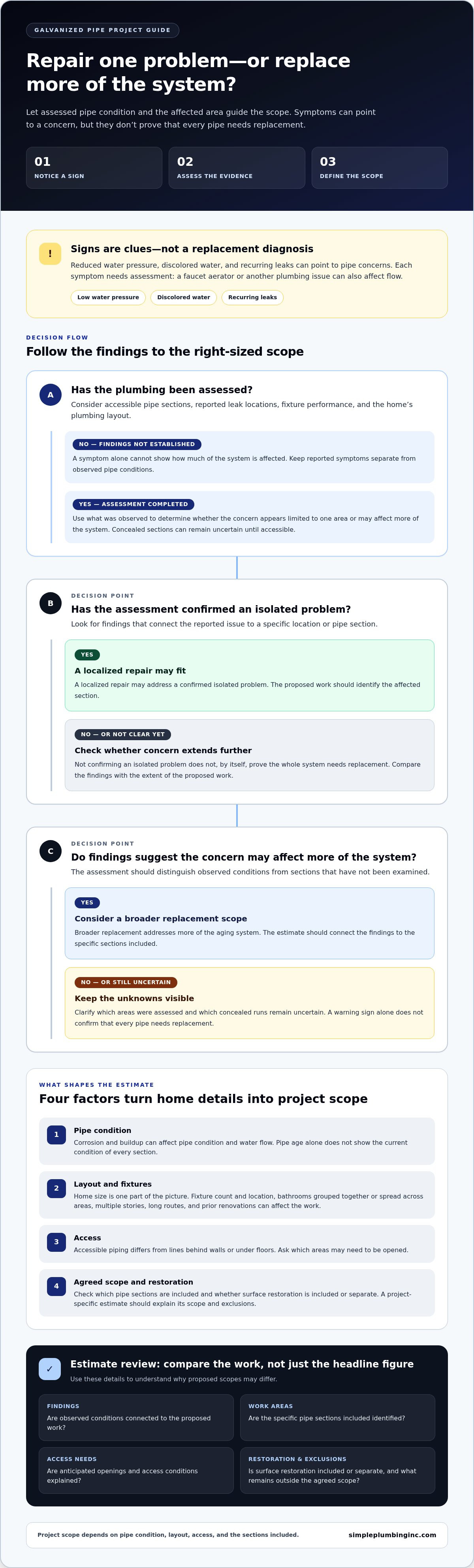
A home’s age provides context, but it doesn’t confirm the condition of every pipe. Visible symptoms also tell only part of the story. Reduced pressure, discolored water, or recurring leaks can indicate a concern, but none automatically proves that the entire system needs replacement. A useful estimate separates observed evidence from areas that haven’t been directly assessed.
If you’ve noticed signs of an active leak, Yucaipa leak detection guidance explains how locating the source can inform decisions about the next step. During an assessment, describe where symptoms occur, when they began, and whether they affect one fixture or multiple areas. This context helps connect the findings to a practical scope.
Every Yucaipa home has its own layout, plumbing history, and access conditions. A careful assessment turns those details into a project plan: which sections are included, what areas may need to be opened, and what remains outside the agreed scope. That gives you a clearer basis for comparing options and deciding how to proceed.
How Galvanized Pipe Condition and Corrosion Change the Project Scope
Galvanized pipes are steel pipes coated with zinc to help protect the metal from corrosion. Over time, the protective layer can wear down and corrosion may develop inside the pipe. Buildup can narrow the path for water and affect how well the plumbing works. Because this change happens inside the pipe, a section can look intact from the outside even when its interior condition is harder to judge.
As corrosion develops, you may notice weaker flow, rusty-looking water, or leaks that return after a repair. These signs are useful clues, but they don’t show how much of the system is affected. A faucet aerator or another plumbing issue can also affect flow. The cause needs to be assessed before deciding whether the project should address one location or more of the system.
What signs can point to aging galvanized pipes?
Keep track of recurring leaks, changes in water pressure, and discolored water. Note which fixtures are affected, whether the symptom comes and goes, and when you first observed it. These patterns can help guide an assessment. One symptom alone doesn’t prove that a pipe is corroded or that whole-home replacement is necessary.
A warning sign is a reason to investigate, not confirmation that every pipe in the home needs replacement. A useful assessment connects reported symptoms with pipe condition and other findings. That distinction matters when you’re weighing the cost to replace galvanized pipes Yucaipa and want to understand what the proposed work is based on.
Water appearance also can’t confirm whether water contains lead. If you have concerns about lead exposure, the EPA guidelines on lead exposure and health effects provide general health information. Don’t treat rusty-looking water as proof of lead, or assume clear water rules it out. A water test is the way to assess lead in water.
How inspection findings shape the replacement plan
A plumber can review accessible pipe sections, reported leak locations, fixture performance, and the home’s plumbing layout. Together, those observations help show whether the concern appears limited to one area or may affect more of the system. Concealed sections can remain uncertain until they’re accessible, so a clear plan should distinguish observed conditions from areas that haven’t been examined.
Before an assessment, jot down a few details to make the discussion more useful:
- Which faucets, showers, or other fixtures show a change.
- Whether the issue affects hot water, cold water, or both.
- Where leaks have appeared and whether they’ve happened more than once.
- Any recent plumbing work or changes you know about.
These notes don’t diagnose the system, but they help focus the inspection and clarify what evidence supports the proposed scope. If symptoms point to an active leak, Simple Plumbing Inc. provides leak detection in Yucaipa to help locate its source. For an explanation of your home’s pipe condition and next steps, Simple Plumbing Inc’s plumbing assessment can help you understand the findings.
Repair or Replace Galvanized Pipes? Compare Scope Before You Decide
A leak in one section doesn’t automatically mean every galvanized pipe needs to be replaced. A localized repair may make sense if an assessment identifies a contained problem and the surrounding system appears serviceable. Broader replacement may be worth considering when findings point to deterioration across multiple areas or failures keep recurring. Let the documented conditions guide the decision rather than relying on a blanket rule.
Compare what each option actually covers. A repair addresses a specific area. Broader replacement covers a larger portion of the piping system, with access and restoration needs shaped by the home and agreed scope.
| Option | Scope | May suit findings such as | Limitations |
|---|---|---|---|
| Localized repair | Fixes a confirmed problem in a specific section of pipe. | An isolated leak or damaged area, with no assessment findings that call for wider work. | Doesn’t renew other galvanized pipes, including concealed sections that weren’t part of the repair. |
| Broader replacement | Replaces a wider portion of the system, as defined in the project plan. | Multiple problem areas, recurring failures, or findings that suggest more widespread deterioration. | Involves a larger scope. Access, restoration, and the areas included should be understood before work begins. |
When might a localized galvanized pipe repair make sense?
A limited repair can be reasonable when an assessment identifies a specific failure and the proposed work focuses on that location. It may address the immediate issue without opening or replacing other piping. Ask for a clear description of what the repair covers and what remains unchanged, so you understand the limits of the work.
Repairing one section doesn’t establish the condition of every pipe in the home. If another leak appears later or symptoms affect different fixtures, that pattern may prompt a wider review. It doesn’t automatically prove the whole system needs replacement, but it gives the plumber more information to consider alongside accessible pipe condition and leak history.
When should broader pipe replacement be considered?
Repeated leaks in separate areas, or inspection findings that show concerns across multiple sections, can support considering a broader replacement plan. The scope should still match the evidence. A clearly mapped plan helps you see which pipes are included, what access may involve, and which sections remain outside the work.
Your priorities matter, too. If you’re planning a renovation, discuss how plumbing work fits with the project and access to concealed lines. If limiting disruption is a priority, compare how different scopes affect the areas that need to be reached. Neither option prevents every future plumbing problem. The goal is to choose work that addresses documented conditions and fits your plans.
When comparing the cost to replace galvanized pipes Yucaipa, set the repair and replacement scopes side by side rather than comparing only the total figures. A smaller repair and a broader project aren’t equivalent estimates. Clear findings, defined work areas, and stated limitations make the tradeoffs easier to weigh.
How to Review a Galvanized Pipe Replacement Estimate in Yucaipa
A clear estimate explains what was found, what work is proposed, and what remains outside the project. Use this checklist to review the scope before comparing totals. If a detail is unclear, ask for a plain-language explanation.
- Confirm the findings. Look for a brief description of the observed pipe condition and the issues behind the recommendation. The estimate should distinguish visible findings from assumptions about concealed piping.
- Map the work area. Check which pipe sections, fixtures, rooms, and connection points are included. Work boundaries matter: selected sections are not the same scope as replacement throughout the home.
- Review access work. Note where walls, ceilings, floors, or other surfaces may need to be opened to reach pipes. Confirm which access points are anticipated and how concealed conditions could affect the plan.
- Clarify testing and restoration. Check whether the scope describes system checks and cleanup. It should also state whether patching, painting, flooring, or other surface restoration is included or handled separately from the plumbing work.
- Compare exclusions and conditions. Review what the estimate leaves out, along with allowances or tasks that may apply only if additional conditions are found. Pay attention to assumptions that could change once concealed piping is accessible.
What should a clear estimate explain?
A useful estimate connects the findings to the proposed work. It identifies the pipe sections and fixtures involved, defines the work boundaries, and describes expected access needs. It also separates plumbing work from wall or surface restoration, so you can see what each part covers. If the plan depends on what’s behind a wall or under a floor, that uncertainty should be stated clearly.
Testing and cleanup also deserve clear treatment. The estimate should explain whether those tasks are part of the plumbing scope and identify any excluded restoration. Not every concealed condition can be known in advance. You should still be able to see what’s included now and what may require a revised scope if conditions differ from what was visible during assessment.
How to compare estimates without overlooking scope
Compare like with like. Put the proposed pipe sections, materials, access work, testing, cleanup, and restoration responsibilities side by side. A lower headline figure may cover fewer rooms, omit surface repair, or leave more work conditional. Separate confirmed tasks from allowances to see what each estimate actually covers.
For a fair comparison, summarize each estimate using the same categories. If one includes access and cleanup while another excludes them, note the difference before weighing totals. This gives you a more useful basis for understanding the cost to replace galvanized pipes Yucaipa for your project, without treating different scopes as equivalent.
Simple Plumbing Inc. provides plumbing services in Yucaipa. Review Simple Plumbing’s services to learn more about the work involved.
What to Expect From Galvanized Pipe Replacement With Simple Plumbing Inc in Yucaipa
Knowing the steps ahead can make pipe replacement easier to plan. The process starts with a conversation about what you’ve noticed, then moves to an assessment, an agreed scope, the plumbing work, and final checks. Simple Plumbing Inc. provides residential and commercial plumbing services in Yucaipa and is veteran-owned and operated by a U.S. Marine Corps veteran.
Before work begins: assessment and project planning
Describe the symptoms you’ve noticed, such as leaks, water discoloration, or changes in pressure. Note which fixtures are affected and when the issue occurs. The assessment considers those details along with accessible piping and the home’s layout. This helps connect the symptoms to observed conditions without assuming that every hidden pipe has the same issue.
Before work starts, review the proposed scope together. Make sure you understand which pipe sections are included, where access may be needed, and which parts of the home may be affected. Discuss what the plumbing work includes and whether surface restoration is handled separately. If concealed conditions differ from what was visible during assessment, make sure any proposed scope changes are explained before additional work proceeds.
Schedule and access needs depend on the home and the approved project scope. A plan involving accessible piping may affect the home differently from one that requires reaching pipes behind walls or under floors. The work area, number of locations, and layout all matter. Discussing these details in advance helps you plan around areas that may be temporarily harder to use, without assuming a timeline that may not fit your home.
During and after the replacement work
During the project, the work follows the agreed scope. Reaching concealed piping may require opening selected surfaces, depending on the route and access plan. Keep the agreed work areas clear and make sure you know which fixtures or spaces may be affected as the work progresses. If a newly visible condition changes what’s practical, the proposed adjustment should be explained so you understand the next step.
After the plumbing work, the completed sections can be checked, and you can review any questions about the work performed. Confirm which areas were replaced, what was tested, and whether any surface repair remains outside the plumbing scope. Clear wrap-up details help you know what was completed and what to monitor going forward.
A project-specific assessment gives you a grounded basis for understanding the cost to replace galvanized pipes Yucaipa. The estimate and schedule should reflect your home’s condition, access, and agreed work, rather than assumptions about another property.
Simple Plumbing Inc. provides plumbing services in Yucaipa. Learn about Simple Plumbing Inc.’s services and discuss the next step for your home.
Take the Next Step With Confidence
You don’t need to have the whole project figured out before taking the next step. Start with what you’ve noticed and what matters most to your household, such as understanding pipe condition or planning around access to certain rooms. A clear conversation can turn uncertainty about the cost to replace galvanized pipes Yucaipa into a practical discussion about your home and possible next steps.
Simple Plumbing Inc. is based in Yucaipa and veteran-owned and operated by a U.S. Marine Corps veteran. Contact Simple Plumbing Inc. to discuss your Yucaipa home’s galvanized pipes and arrange a plumbing assessment.
Frequently Asked Questions
Can I identify galvanized pipes without opening a wall?
Sometimes. Exposed piping and accessible connections can offer clues, but paint, corrosion, or later changes may make visual identification uncertain. Concealed pipes behind walls or under floors are harder to assess without access. If you’re researching the cost to replace galvanized pipes Yucaipa homeowners may face, remember that identifying the material is only a first step. Age or appearance alone can’t confirm internal corrosion or determine the right replacement scope.
Will replacing galvanized pipes require opening walls?
Not always. The access needed depends on how the pipes run and which replacement plan is approved. Some sections may be reachable through existing openings, while concealed lines can require access through walls, ceilings, or other areas. Before work begins, review which locations may be opened and how they’ll be accessed. The agreed scope should also state whether patching or other surface restoration is included or separate.
How long does galvanized pipe replacement take in a Yucaipa home?
There isn’t one schedule that fits every Yucaipa home. Timing depends on the layout, number and location of fixtures, pipe access, and the approved scope. For example, a plan involving hard-to-reach lines may require different preparation from work on accessible piping. Discuss scheduling after the home has been assessed and the project boundaries are clear. That conversation can account for the work areas and help you plan household routines.
Does homeowners insurance cover galvanized pipe replacement?
Coverage depends on your policy, the cause of damage, and the circumstances of your claim. An insurer may treat sudden damage differently from planned replacement of aging plumbing, but coverage terms vary. Review your policy language and speak with your insurer about your specific situation before relying on coverage for the work. Simple Plumbing can explain plumbing findings and project scope, but your insurer determines whether a claim is covered.
Do I need a permit to replace galvanized pipes in Yucaipa?
Permit requirements depend on the project scope and current local rules, so don’t assume every job has the same answer. Before work is scheduled, verify the requirements that apply to your property and proposed plumbing changes with the relevant Yucaipa or San Bernardino County building authority. Confirm which jurisdiction handles your address. Base the permit decision on current guidance and the actual work planned, not a general rule of thumb.
Can galvanized pipes affect the appearance of household water?
They can be one possible cause of rusty-looking or discolored water, but appearance alone doesn’t identify the source. For example, discoloration that appears only at one fixture may point to a different issue than a change throughout the home, though neither pattern confirms a diagnosis. Note which taps are affected, whether the color clears or returns, and when it occurs. If discoloration persists or recurs, arrange an assessment to investigate.


