
Did you know that the "very hard" water in cities like San Bernardino and Fontana can start degrading your brand-new pipes and appliances before you've even finished unpacking? It's a frustrating reality for many local families. You're investing a lot into your dream home, and the last thing you want is a hidden leak or a failing water heater just a few years down the road. We agree that the construction process feels overwhelming, especially when you're trying to keep track of shifting regulations and technical details.
That's why we've put together this new construction plumbing checklist Inland Empire homeowners can rely on. It's a straightforward guide to ensure your build is efficient, durable, and fully code-compliant. We'll show you exactly what to look for to protect your investment, from meeting the 2025 California Plumbing Code standards to securing your water heater for seismic safety. This guide covers everything from the latest flow rate requirements to the mineral management strategies that keep your equipment running for decades. You'll get a clear, step-by-step preview of how to ensure your home's plumbing is future-proofed against Southern California's unique environmental challenges.
Key Takeaways
- Understand why the Inland Empire's high mineral content and seismic activity require specific plumbing materials and safety valves from the start.
- Use this new construction plumbing checklist Inland Empire to verify critical rough-in details like pipe materials and drainage slopes before the walls go up.
- Learn how to identify and test essential shut-off valves for every fixture so your family can stop leaks quickly in an emergency.
- Discover why pre-plumbing a water softener loop is a smart, low-cost step to protect your new appliances from local hard water damage.
- Find out what specific documentation and high-standard inspections you need to secure your home’s long-term reliability and warranty coverage.
What is New Construction Plumbing and Why Does the Inland Empire Require a Specific Approach?
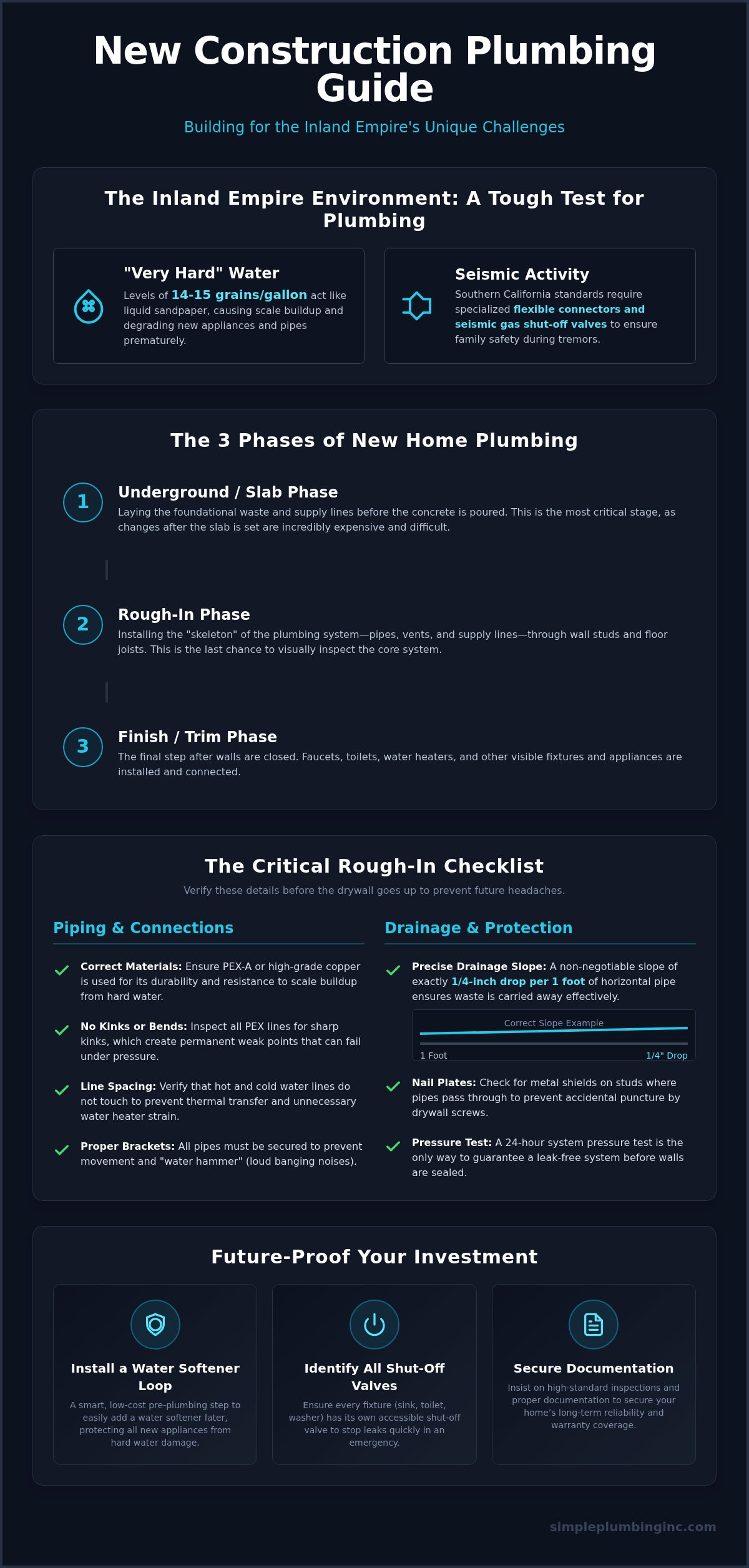
New construction plumbing is the complete installation of a home's water supply and waste removal system from the ground up. It isn't just about sticking pipes in walls. It's a complex, three-stage process that requires precision to ensure your home stays dry and functional for decades. In our region, a standard approach isn't enough. Using a new construction plumbing checklist Inland Empire homeowners can follow is vital because our local environment is tough on standard materials. We deal with specific geological and chemical challenges that builders in other states simply don't face.
The Three Phases of New Home Plumbing
The process starts with the underground or slab phase. This is where we lay the foundation for your waste and supply lines before the concrete is poured. It's the most critical stage because once the slab is set, changes become incredibly expensive. Next is the rough-in phase. We install the "skeleton" of the Plumbing systems through the wall studs and floor joists. This includes all the vent pipes and supply lines. Finally, the finish or trim phase happens after the walls are closed. This is when we install the faucets, toilets, and water heaters you use every day.
Why Inland Empire Soil and Water Matter
Our local conditions demand more than just "meeting code." In cities like Riverside and San Bernardino, water hardness levels often hover between 14 and 15 grains per gallon. This "very hard" water acts like liquid sandpaper on your fixtures. If your new construction plumbing checklist Inland Empire doesn't include mineral management, your new appliances will suffer. Additionally, our local soil can be expansive. If a plumber doesn't use the right pipe bedding, the shifting earth can snap a line under your foundation. We also have to account for seismic activity. Southern California standards require specific flexible connectors and seismic gas shut-off valves to keep your family safe during a tremor.
You shouldn't be a passive observer during this build. "Meeting code" is the bare minimum a builder must do to avoid a fine. It doesn't mean the work is high quality or designed to last fifty years. By understanding these phases and local risks, you move from being a bystander to an informed quality controller. It's your home. You deserve a system that's built for the Inland Empire, not just a generic blueprint.
The Rough-In Checklist: Inspecting the Skeleton of Your Home
Once your home is framed, the plumbing "rough-in" begins. This is the most important part of your new construction plumbing checklist Inland Empire because it's your last chance to see the pipes before they disappear behind drywall. We look for a "straight shooter" level of quality here. If the layout looks messy now, it will likely cause problems later. High-quality work is always organized and logical.
Piping and Connection Integrity
We start by verifying materials. Most modern builds use PEX-A or high-grade copper. PEX-A is excellent for its flexibility and resistance to the scale buildup caused by Hard water, which is a constant reality in Southern California. Look closely for any kinks in these lines. A kinked PEX line creates a permanent weak point that can fail under pressure. We also check the spacing between hot and cold lines. They shouldn't touch; if they do, thermal transfer will make your water heater work much harder than it needs to. Every pipe must be secured with proper brackets to prevent "water hammer," that loud banging noise that occurs when a valve closes suddenly.
Drainage requires just as much attention. We look for a consistent slope of exactly 1/4-inch of drop for every foot of horizontal pipe. If the slope is too shallow, waste won't move. If it's too steep, the water outruns the solids, leaving them behind to cause clogs. We also verify the placement of vent stacks. Proper airflow is the secret to fast, quiet drains. Finally, we check for nail plates. These metal shields are installed on studs where pipes pass through to prevent drywall screws from piercing a line. It's a small detail, but it prevents a massive headache down the road.
The Pressure Test: Your Non-Negotiable Step
A 24-hour pressure test is the only way to guarantee a leak-free system before drywall. We pump the entire system with air or water and attach a pressure gauge. If that needle moves even a fraction of an inch by the next morning, there's a leak somewhere in the skeleton. It's that simple. There is no room for "maybe" when the pipes are about to be sealed away for decades. For more details on these technical requirements, you can review our guide to New Construction Plumbing in Yucaipa. Getting this step right ensures your home starts on a solid foundation. If you need a professional set of eyes to verify your rough-in, the team at Simple Plumbing Inc provides thorough inspections to keep your project on track.
Fixtures, Appliances, and the Finish Phase
The finish phase is where your house finally starts feeling like a home. This is the stage of the new construction plumbing checklist Inland Empire where we install the parts you actually see and touch. It's more than just aesthetics; it's about making sure every connection is watertight and every valve is easy to operate. If a pipe bursts at 2:00 AM, you don't want to be searching for a buried shut-off valve with a flashlight.
We start with the main water shut-off. It should be in a location every family member knows and can access without a wrench. We also insist on high-quality individual fixture stops. Every toilet and sink needs its own dedicated valve. This allows you to perform a simple repair on one faucet without shutting off water to the entire house. Cheap plastic valves are a common corner-cut in new builds, so look for solid metal quarter-turn valves that won't seize up over time. These are the small details that prevent domestic chaos later.
Water Heater and Supply Optimization
Choosing between a tankless and a traditional water heater depends on your family's habits and the local climate. Tankless units provide endless hot water, but they require specific gas line sizing and proper venting to meet the 2025 California Plumbing Code. If you go with a traditional tank, we verify that a thermal expansion tank is installed. This small tank prevents pressure spikes that can damage your pipes as water heats up. For a deeper look at your options, check out our guide on Water Heater Replacement in Yucaipa.
Fixture Installation Quality
Once the fixtures are in, we run a series of simple tests. We check every toilet for "rocking." If it moves when you sit on it, the flange seal is likely compromised, which leads to slow leaks and floor rot. We also pull the aerators off every faucet after the first flush. Construction debris often gets trapped there, which can ruin your water pressure on day one. Finally, we verify that your dishwasher and laundry lines have proper air gaps or high loops. This prevents dirty drain water from siphoning back into your clean appliances. A quick check of the grout and silicone seals around your tubs and showers is the final step of your new construction plumbing checklist Inland Empire to keep water where it belongs.
Inland Empire Specifics: Hard Water and Seismic Safety
Building in the Inland Empire comes with a unique set of environmental challenges that a generic plumbing guide won't address. Our region is known for its high mineral content and active fault lines. These aren't just minor inconveniences; they are factors that can shorten the life of your plumbing system by years if you don't account for them early. Your new construction plumbing checklist Inland Empire must prioritize these local realities to ensure your home remains safe and efficient.
One often overlooked component is the Pressure Reducing Valve (PRV). Municipal water pressure in parts of the IE can be surprisingly high. Without a properly calibrated PRV, this pressure can stress your pipe joints and cause faucets to leak prematurely. We also plan for our dry climate by installing drought-resistant irrigation systems and frost-proof hose bibs. These steps protect your outdoor plumbing during our intense summer heat and the occasional winter freeze.
Managing Inland Empire Hard Water
Hard water is the primary enemy of new appliances in our area. In cities like San Bernardino and Fontana, water hardness levels reach 15 grains per gallon. Riverside isn't far behind at 14 grains per gallon. This mineral buildup acts like a slow-moving clog, coating the inside of your pipes and heating elements. We strongly recommend "looping" for a water softener during the rough-in phase. Even if you don't buy the equipment on day one, having the pre-plumbed loop saves you from expensive repiping later. For more details on protecting your home, read our guide on Hard Water Solutions in Yucaipa CA.
Seismic and Structural Plumbing Safety
Living in Southern California means preparing for seismic activity. The 2025 California Plumbing Code, which goes into effect for new permits in 2026, reinforces strict safety standards. Every new water heater must be securely strapped to the wall at two points to prevent tipping during a tremor. We also ensure that all gas lines use flexible connectors where they meet appliances. This flexibility allows the pipes to move slightly without snapping or leaking gas.
Most new builds in our area also require integrated fire sprinkler systems. We verify that these lines are separate from your main domestic supply to ensure they always have the pressure needed for an emergency. If you want to ensure your new build is fully protected from local water conditions, the team at Simple Plumbing Inc can help you design a system that lasts. Taking these steps now provides the predictable, reliable home environment every homeowner deserves.
Final Walkthrough and the Veteran-Owned Quality Standard
The final walkthrough is your last opportunity to ensure the builder's work meets your standards before you take full possession. As a veteran-owned business, we approach this phase with what we call the "Marine Corps Eye." This means we don't just look for shiny faucets; we look for the discipline and integrity behind the installation. A straight shooter doesn't hide mistakes behind cabinets or under sinks. We believe in total transparency because a home is the biggest investment you'll ever make. This final check is about more than aesthetics. It's about verifying that every component is ready for decades of service.
We always suggest a third-party plumbing inspection before your one-year builder's warranty expires. Builders often move quickly, and a fresh set of eyes can catch small issues that might turn into major leaks once the warranty is gone. It's a small investment that provides peace of mind and saves you from paying for repairs that the builder should have covered. We provide honest answers and clear documentation so you know exactly where you stand.
What to Ask Your Builder Before Signing Off
Request a copy of the "slab map" or as-built blueprints. This document shows exactly where your pipes run under the concrete floor. It's essential for any future renovations or if you ever need to pinpoint a leak. You also need to confirm the location of all exterior cleanouts. Knowing these locations makes sewer line maintenance much easier and prevents your yard from being dug up unnecessarily. Finally, verify that every permit is closed and the final inspections are signed off by the local building department. Do not accept a verbal "it's all good" from the contractor.
Long-Term Maintenance for Your New System
Even the best systems need regular care to stay efficient. Your new construction plumbing checklist Inland Empire should include a schedule for routine tasks. For instance, you should flush your new water heater every six to twelve months. This prevents the hard water minerals we discussed earlier from turning into a thick layer of sediment that kills your heater's efficiency. You should also monitor your home for "settling leaks" during the first twelve months. As a new house settles into the Inland Empire soil, pipes can shift slightly, which may cause small drips at joints or valves. Catching these early prevents water damage and mold growth.
If you're ready to ensure your new build is truly up to code and built to last, we're here to help. Schedule a professional new construction walkthrough with Simple Plumbing Inc today.
Secure Your Home's Future with a Reliable Plumbing Foundation
Building a home in the Inland Empire is a major milestone. You've learned that standard plumbing isn't enough for our local conditions. Protecting your investment means accounting for very hard water and seismic safety from the very first day. By using this new construction plumbing checklist Inland Empire homeowners can ensure their pipes and appliances are built to last for decades. It's about moving beyond basic code compliance to reach a higher standard of reliability and safety.
Simple Plumbing Inc is veteran-owned and operated. We bring Marine Corps attention to detail to every project we touch. We serve Yucaipa and the broader Inland Empire with integrity and a straightforward approach. You deserve a plumbing system that works perfectly without any hidden surprises. If you want a partner who values honesty as much as you do, we are ready to help. Get a Straightforward Quote for Your New Construction Project today. Your dream home deserves a plumbing system that's as solid as its foundation. We look forward to helping you build something great.
Frequently Asked Questions
Is a city plumbing inspection enough for a new construction home?
No, a city inspection only confirms that the work meets the bare minimum safety codes. Inspectors don't check for long term durability or high quality craftsmanship. Hiring an independent expert ensures that your system is built to last for decades, not just until the final permit is signed. We look for the small details that city officials often overlook during a busy day of site visits.
What is the most common plumbing mistake in new construction?
The most frequent error is an improper drainage slope. If a pipe doesn't have a consistent quarter-inch drop per foot, you will face constant clogs and backups. We also see many builders skip nail plates on studs. This leads to drywall screws piercing pipes weeks after the plumbing was finished. These mistakes are easy to prevent but very expensive to fix once the walls are closed.
Do I really need a water softener for a brand-new house in Yucaipa?
Yes, a water softener is a day-one necessity in Yucaipa because our local water is classified as very hard. Without one, mineral scale will begin coating the inside of your new tankless water heater and faucets immediately. This buildup reduces efficiency and can void appliance warranties. Installing a softener protects your investment and keeps your new fixtures looking and performing like they should for years.
What type of piping is best for new homes in the Inland Empire?
PEX-A is generally the superior choice for most Inland Empire builds. It is highly flexible and resists the mineral corrosion that often plagues copper pipes in our region. PEX-A also handles our local water pressure fluctuations better than older materials. It is less likely to burst during a freeze and doesn't develop the pinhole leaks that can occur with traditional metal piping over time.
How long does a typical new construction plumbing installation take?
A complete installation typically takes two to three weeks of active labor spread across several months. The underground phase usually takes three days, while the rough-in requires about a week of work. The final trim phase, where we set the fixtures and water heater, takes another three to five days. The total timeline depends on the complexity of your home and how quickly the other trades finish their work.
When should I call my own plumber during the building process?
You should involve your own plumber at least twice: before the slab pour and again during the rough-in phase. These are the only times the "skeleton" of your home is visible. An independent review during these windows allows you to catch errors before they are buried in concrete or behind drywall. It is much easier to move a pipe now than it is to jackhammer your floor later.
What is a seismic gas shut-off valve, and do I need one?
A seismic gas shut-off valve is a safety device that automatically closes your gas line during a significant tremor. While not always a statewide mandate for every home, it is a critical safety upgrade for anyone living in Southern California. These valves prevent fires by stopping gas leaks if a line snaps during an earthquake. It is a simple, mechanical solution that provides massive peace of mind for local families.
Can I change my plumbing layout after the slab is poured?
You can change the layout, but it is incredibly costly and labor-intensive. It requires jackhammering the new concrete to move the drain and supply lines. This is why finalizing your new construction plumbing checklist Inland Empire before the foundation is poured is so important. We always recommend double-checking your floor plan and appliance locations during the underground phase to avoid these expensive structural changes later.


