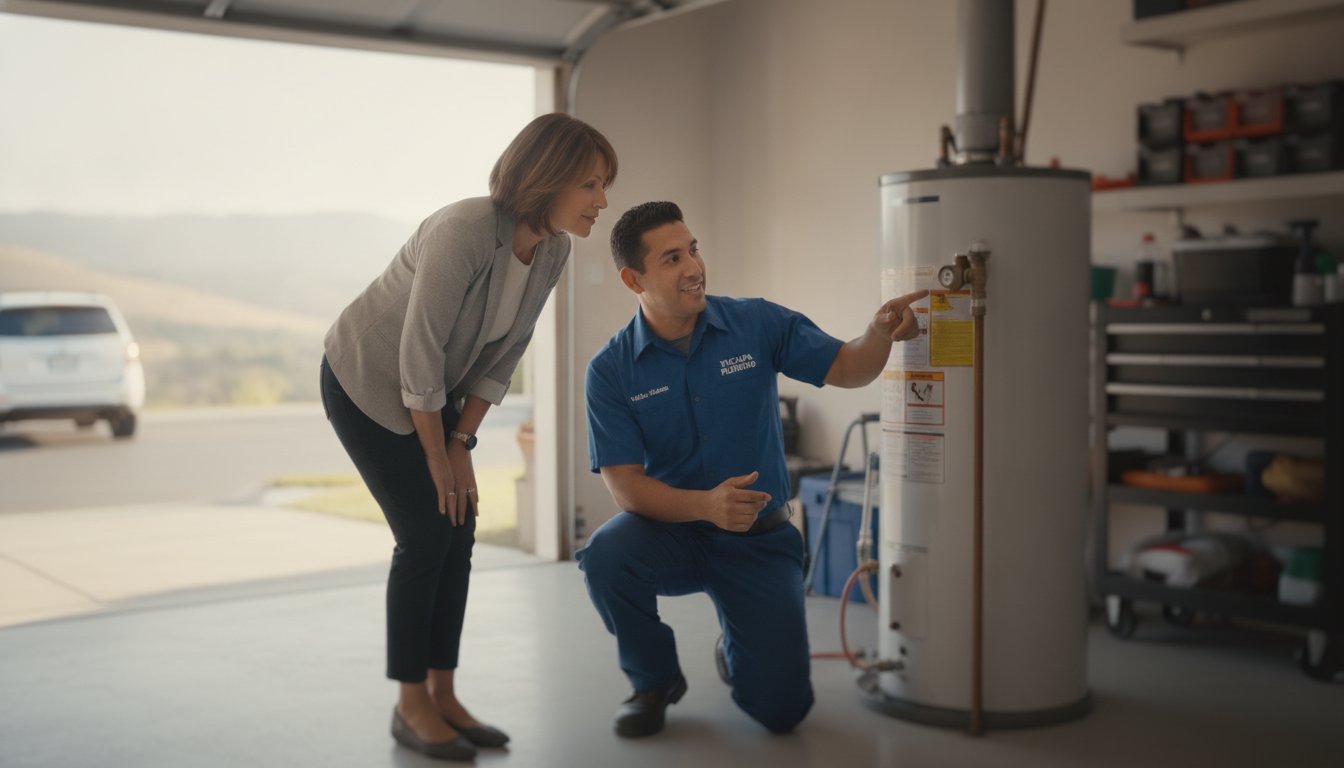
Imagine walking into your garage on a Monday morning only to find two inches of standing water surrounding your water heater. It's a stressful, messy situation that most Yucaipa homeowners want to avoid at all costs. You likely want to know how long do water heaters last so you can plan ahead rather than reacting to a flood. It is hard to find a straight answer when online sources provide so many conflicting ranges that don't account for our local conditions.
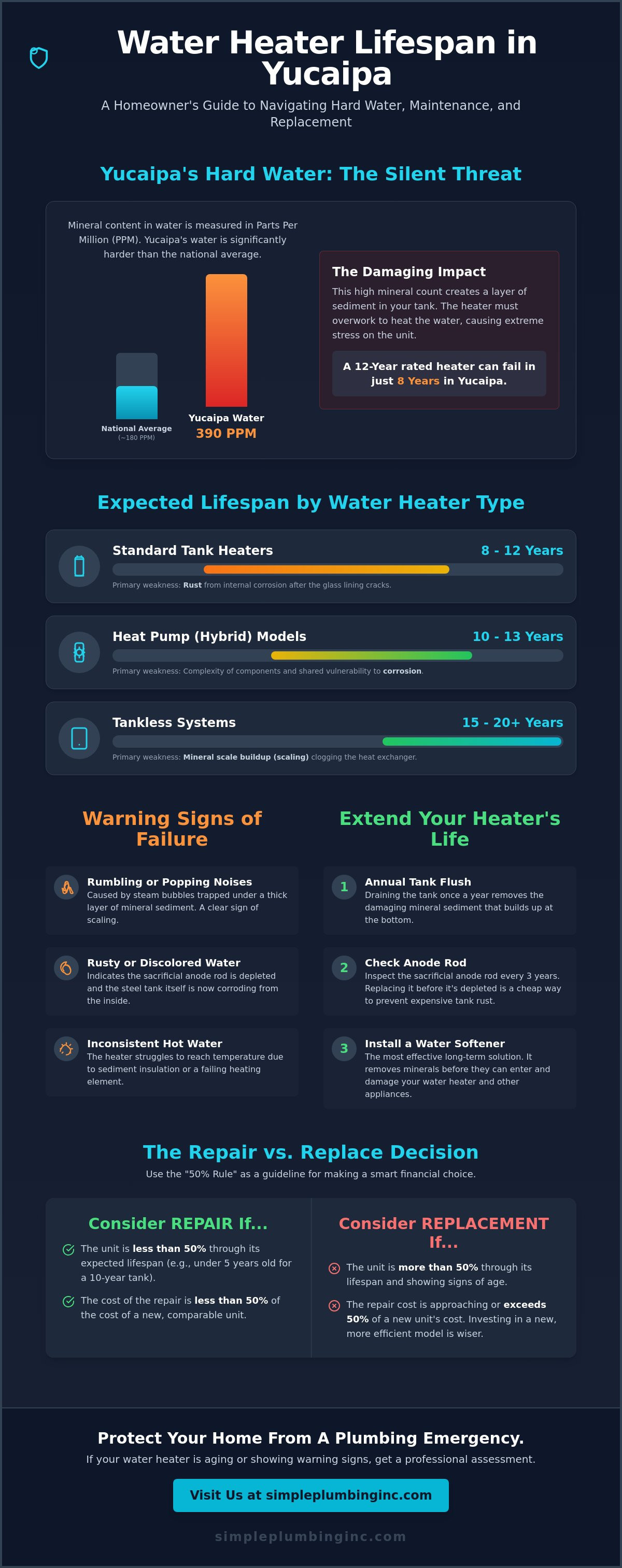
We want to give you the facts without any fluff or high-pressure sales tactics. While a manufacturer might claim a tank lasts 12 years, Yucaipa’s water has a mineral level of 390 ppm. This high sediment count typically shortens the life of a standard tank to about 8 or 10 years. This guide will help you understand the typical lifespan of different units and how Yucaipa’s specific water quality impacts your home. You will also find simple maintenance steps to delay replacement costs and keep your morning showers warm.
Key Takeaways
- Understand how long do water heaters last based on whether you have a standard tank or a high-efficiency tankless model.
- See why Yucaipa’s specific mineral levels often mean your equipment needs more attention than the national average.
- Learn how to spot early red flags like tank age and rusty water before they turn into a plumbing emergency.
- Follow a straightforward maintenance routine to protect your investment and extend the life of your current unit.
- Use the "50% Rule" to determine if a repair is a smart fix or if it’s time to consider a more reliable replacement.
Average Lifespan: How Long Should Your Water Heater Work?
Most homeowners only think about their plumbing when something goes wrong. We prefer a more proactive approach. We often call it the "Marine Corps" method of home maintenance. It simply means that predictability beats surprises every time. This philosophy extends to your HVAC system as well; Caribbean Heating & Cooling provides the same level of proactive care for your home's heating and cooling needs. You want to know exactly how long do water heaters last so you can replace the unit on your own schedule. You don't want to wait for a puddle to form in your garage at 2:00 AM.
Homeowners often ask how long do water heaters last when they start noticing small changes in their hot water supply. While every home is different, there are reliable industry averages for each type of equipment. Knowing these timelines helps you stay ahead of the curve and budget for the future. Here is what you can generally expect from modern systems:
- Standard Tank Units: 8 to 12 years.
- Heat Pump Models: 10 to 13 years.
- Tankless Systems: 15 to 20 years.
Traditional Tank Water Heaters
Standard storage water heaters rely on a steel tank to hold and heat your water. To prevent the steel from rusting, manufacturers coat the inside with a thin layer of glass. This glass is durable, but it isn't perfect. Over years of constant heating and cooling, the steel expands and contracts; this movement eventually creates tiny cracks in the glass lining.
Once water touches the bare steel, rust is inevitable. Every tank includes a sacrificial anode rod to help delay this process. This rod is designed to corrode so your tank doesn't have to. When the rod is gone, the tank is next. In ideal conditions, the average life of a traditional tank unit is 10 years.
Tankless and Modern Alternatives
Tankless units work differently because they don't store water. They heat it on demand using a high-powered heat exchanger. By removing the storage tank, you eliminate the most common cause of catastrophic leaks. This design is why a tankless water heater installation in Yucaipa can often double the service life of your system compared to a standard tank.
However, these systems have their own challenges. Scale buildup is the "silent killer" of tankless heat exchangers. In areas with hard water, minerals can form a hard crust inside the narrow passages of the unit. This makes the system work much harder to reach the right temperature. Without regular cleaning, this strain can lead to an early failure. Even the best technology needs a little help to reach that 20-year milestone.
Why Yucaipa Water Quality Shortens Equipment Life
Yucaipa and the Inland Empire are beautiful places to live, but our local water presents a specific challenge for home appliances. The water in our area is known for having a high mineral content, often referred to as "hard water." Local reports show that Yucaipa’s water has a Total Dissolved Solids (TDS) level of 390 ppm. This is significantly higher than the national average. When you wonder how long do water heaters last, the answer depends heavily on how your system handles these minerals.
Just as hard water affects your plumbing, the regional climate puts a strain on your HVAC system; it is often helpful to explore Air Conditioning Repair & Installation to ensure your entire home remains efficient and comfortable year-round.
Calcium and magnesium don't just flow through your pipes; they settle at the bottom of your tank. This creates a thick, insulating layer of sediment. If you have a gas water heater, the burner is located right at the bottom. The heat must travel through that layer of "rock" before it can even begin to warm the water. This forces the burner to work much harder and stay on longer. The resulting heat stress can reduce a unit with a 12-year manufacturer rating to an 8-year unit in just a few seasons.
The Impact of Mineral Scaling
You can often hear the effects of hard water before you see them. If your heater makes a "popping" or "rumbling" sound, it means steam bubbles are being trapped under a layer of sediment. This is a clear sign of mineral scaling. The chemical reaction between Yucaipa’s minerals and your heating elements can lead to rapid corrosion. This damage often causes hidden pinhole leaks. If you are concerned about moisture around your unit, our experts can provide leak detection in Yucaipa CA to ensure your foundation is protected.
Solutions for Hard Water Regions
There are ways to fight back against local water conditions. Installing a water softener is one of the most effective ways to extend your heater’s life by several years. By removing the minerals before they reach the tank, you prevent the insulating layer from ever forming. The U.S. Department of Energy notes that regular maintenance is essential for storage units, especially in areas with high mineral counts.
In Southern California, we recommend flushing your tank more frequently than the national standard. A quick annual flush might not be enough for a TDS of 390 ppm. For homeowners planning a new build, Simple Plumbing Inc recommends integrated pre-filtration for new construction plumbing projects. This proactive step keeps your new equipment running efficiently for as long as possible. We want to help you get every year of service you were promised when you bought your unit.
Warning Signs Your Water Heater is Reaching Its Limit
You don't need to be a professional plumber to spot the early signs of a failing system. Most homeowners start asking how long do water heaters last when they notice a change in their morning routine. Perhaps the water isn't as hot as it used to be, or you hear strange noises coming from the garage. Catching these red flags early can be the difference between a planned upgrade and an emergency cleanup.
Age is your first and most reliable indicator. Every unit has a manufacturer label, usually found near the top or side of the tank. This label contains a serial number that includes the build date. If your system is approaching the 10-year mark in Yucaipa, it is likely reaching the end of its reliable service life. While some units may push further, the risk of a sudden failure increases significantly after a decade of dealing with local water conditions. This awareness of equipment age should extend to your home's fireplace and chimney; experts like Home Safe Hearth & Chimney provide the inspections needed to ensure these systems remain safe as they age.
Discolored or "rusty" water is another common warning. If you turn on the hot tap and see a reddish or brown tint, it often means the internal lining of your tank is deteriorating. However, you should check your cold water as well. If the cold water is clear and only the hot side is discolored, the problem is almost certainly your water heater. If both are rusty, the issue might be your home's older galvanized pipes instead.
Physical Indicators of Failure
Visible moisture around the base of the unit is a sign that cannot be ignored. You should check if the water is coming from the Temperature and Pressure (T&P) relief valve or the tank itself. A T&P valve might just be doing its job by releasing excess pressure, which is often a simple fix. A pinhole leak in the tank wall, however, is a terminal condition. Any puddle under a heater requires an immediate professional look to prevent a major flood.
Performance Changes
If your shower gets cold much faster than it did last year, you likely have a broken dip tube. This tube is responsible for sending cold water to the bottom of the tank to be heated. When it breaks, cold water stays at the top and mixes with your hot water supply. You might also notice a failure in one of the heating elements if you have an electric model. This results in lukewarm water that never quite reaches the right temperature. Here is a straight shooter tip: don't ignore small drips or minor temperature changes; they never fix themselves and usually lead to bigger bills later. Understanding how long do water heaters last helps you realize when these performance drops are a sign of total system fatigue rather than a simple part failure.
Simple Steps to Add Years to Your Water Heater
When people ask how long do water heaters last, they usually assume the answer is fixed by the manufacturer. It isn't. While you cannot change the mineral content of Yucaipa's water, you can control how those minerals affect your tank. Maintenance is the single most important factor in determining if your unit survives for eight years or fifteen. Taking a few proactive steps can save you from the stress of a sudden failure.
This focus on maintenance is universal for all heating equipment, including residential boilers. For insights into professional servicing standards, you can learn more about Trust Boilers & Renewables and their approach to system care.
Start with your thermostat. Most units come from the factory set to 140°F, but we recommend lowering it to 120°F. This small change reduces the internal heat stress on the tank and slows down the rate of mineral scaling. You should also check your temperature and pressure (T&P) relief valve twice a year. Simply lift the lever to ensure water flows out and stops when you release it. If it doesn't, the valve is stuck and needs attention immediately.
The Annual Flush Routine
Flushing your tank is essential in Southern California. This process removes the loose sediment before it has a chance to harden into a thick layer of scale. To do this safely, you must first turn off the heat source. For gas units, turn the dial to "Pilot." For electric units, turn off the breaker. Close the cold water supply valve and connect a standard garden hose to the drain valve at the bottom of the tank.
Run the other end of the hose to a floor drain or outside. Open a hot water faucet elsewhere in the house to prevent a vacuum, then open the drain valve. You will likely see cloudy water or small white flakes. Keep draining until the water runs completely clear. This is critical for Yucaipa residents because our high sediment levels can quickly clog a drain valve if left too long between flushes.
Anode Rod Maintenance
Think of the sacrificial anode rod as a lightning rod for corrosion. It is a magnesium or aluminum rod that hangs inside your tank. Its only job is to attract the corrosive elements in the water so they eat the rod instead of your steel tank. We recommend inspecting this rod every two to three years. If the rod is depleted to the point where the wire core is visible, it is time for a new one.
Spending about $50 on a new rod every few years can easily save you a $1,500 replacement cost. As a veteran-owned company, we believe in the value of preventive maintenance over reactive repairs. It is much easier to swap a rod on a Tuesday afternoon than it is to replace a flooded basement on a Sunday morning. If you aren't comfortable handling these steps yourself, you can always reach out to Simple Plumbing Inc for a professional maintenance visit.
The Repair vs. Replace Decision: A Honest Assessment
Deciding whether to sink money into an old unit or invest in a new one is a stressful choice. You don't want to waste money on a temporary fix, but you also don't want to replace a system that still has years of life left. When you look at how long do water heaters last in our region, you have to be realistic about the age of your equipment. A standard tank that has already served ten years in Yucaipa is often a candidate for replacement rather than repair.
We recommend using the "50% Rule" to make your choice easier. If a repair estimate costs half as much as a new unit, it is usually smarter to replace it. This is especially true for older systems. Beyond the immediate repair cost, you should factor in energy efficiency. Modern units are designed to meet strict California standards and can save you 10% to 20% on your monthly gas bills compared to models from a decade ago. Simple Plumbing Inc provides clear, upfront options so you can choose the path that fits your budget and your home's needs.
When Repair is the Right Move
Not every problem requires a brand new installation. If your unit is only five or six years old, many issues are worth fixing. Common repairs include replacing a pilot light, a thermocouple, or a single heating element. These are relatively minor components that don't affect the structural integrity of the tank. We also frequently replace leaky drain valves or T&P valves to stop minor drips. Our team always prioritizes the most cost-effective solution for you, a standard also upheld by quality providers like NBS Plumbing & Heating. If a simple part can safely extend the life of your unit, we will tell you.
When Replacement is Unavoidable
There are some signs that a unit has reached its terminal point. If the actual steel tank is cracked or showing signs of massive internal corrosion, a repair isn't possible. Structural rust around the bottom of the tank is a major red flag that a flood is imminent. In these cases, replacement is the only way to ensure your home stays dry and your water stays hot. While a new system is an investment, it also brings the peace of mind that comes with a fresh manufacturer warranty and reliable performance. If you are unsure about the state of your system, your next step should be to Schedule a professional water heater assessment in Yucaipa. We will give you a straight answer on how long do water heaters last in your specific situation so you can make an informed decision.
Take Control of Your Home’s Hot Water
Understanding how long do water heaters last is about more than just numbers; it is about protecting your home and your budget. While Yucaipa’s hard water presents a challenge, you now have the tools to manage it. Regular flushing and timely anode rod checks can keep your system running efficiently for years. If you spot rusty water or hear those tell-tale rumbling sounds, you don't have to face the decision alone. We are here to provide clear answers based on your unit’s actual condition.
Simple Plumbing Inc has been providing expert local service to Yucaipa since 2023. As a veteran-owned and operated business, we value integrity and transparent pricing above all else. You won't find any high-pressure sales tactics here, just honest advice from neighbors who know the local water conditions. Whether you need a simple flush or a full replacement, we will help you find the most cost-effective path forward. Get an honest water heater assessment from Simple Plumbing Inc today and enjoy the peace of mind that comes with a reliable system.
Frequently Asked Questions
Is a 12-year-old water heater too old?
Yes, a 12-year-old unit is generally considered past its prime for our area. Most tank units in Yucaipa reach the end of their reliable life between 8 and 10 years because of the high mineral content in our water. While it might still be heating water today, the internal lining is likely thin and prone to a sudden failure.
Replacing a unit at this age is a smart, proactive move. It allows you to choose a new, energy-efficient model on your own schedule. Waiting for it to fail often means making a rushed decision during a plumbing emergency.
What is the first thing to go on a water heater?
The sacrificial anode rod is almost always the first component to fail. It is designed to be the "weakest link" so it corrodes instead of your tank. Once this rod is completely dissolved, the minerals in the water begin attacking the steel walls of the heater itself.
In electric models, the heating elements are also frequent early failure points. In gas models, you might see the thermocouple or pilot assembly wear out first. Most of these individual parts are replaceable if the tank itself is still in good structural shape.
Can a water heater last 20 years?
Standard tank water heaters rarely reach the 20-year mark in Southern California. The constant stress of hard water and heat usually causes the tank to leak long before then. However, tankless water heaters are built differently and can easily last 20 years or more with the right maintenance.
If you have a traditional tank, expecting more than 12 to 15 years is risky. Proper maintenance like annual flushing can help, but the physical limits of the steel tank eventually win out.
How do I know if my water heater is still under warranty?
You can verify your warranty status by checking the manufacturer’s website with your unit’s serial number. This number is printed on the large rating plate on the side of the tank. Most residential water heaters come with a limited warranty that covers the tank for 6, 9, or 12 years.
Keep in mind that these warranties usually cover the cost of the tank but not the labor to install it. If you cannot find the serial number, a local professional can help you identify the age and coverage of your system.
Does a tankless water heater really last longer in Yucaipa?
Yes, tankless models generally offer a much longer service life because they don't store water. This eliminates the primary cause of failure, which is tank corrosion. When homeowners ask how long do water heaters last in a tankless format, the answer is often 15 to 20 years.
There is a catch for Yucaipa residents. Our local water has a TDS level of 390 ppm, which can lead to rapid scale buildup in the narrow passages of a tankless unit. You must perform an annual descale to ensure the system reaches its full potential.
Will a leaking water heater explode if I don’t fix it?
It is extremely unlikely for a water heater to explode simply because it has a leak. Modern units are equipped with a Temperature and Pressure (T&P) relief valve specifically designed to prevent dangerous pressure build-up. An explosion usually only occurs if those safety devices are tampered with or fail during a runaway heating event.
The real danger of a leak is the massive water damage it can cause to your home. A small drip can quickly turn into a flood that ruins drywall, flooring, and personal belongings. If you see water, it is best to turn off the supply immediately.
Should I replace my water heater before it starts leaking?
Replacing an old unit proactively is the best way to avoid a domestic disaster. If your unit is over 10 years old, you are essentially living on borrowed time. Planning a replacement now lets you compare different models and find a price that fits your budget without the pressure of an active leak.
Proactive replacement also ensures you aren't forced to deal with a cold shower or a flooded garage on a weekend or holiday. It is one of the simplest ways to maintain a predictable, stress-free home.


