
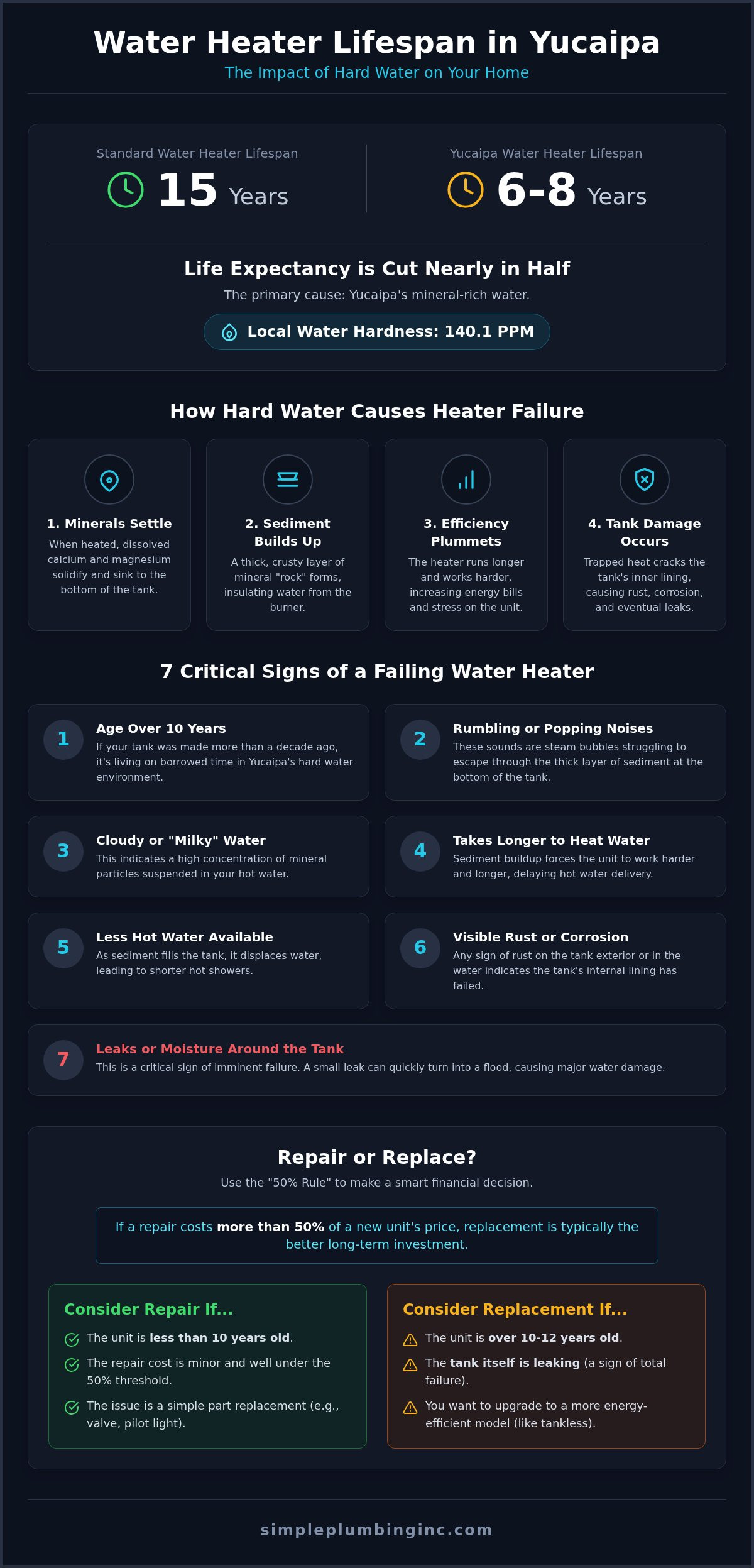
Did you know that the mineral-rich water flowing from the San Bernardino Mountains can cut your water heater’s life expectancy nearly in half? While most tanks are built to last fifteen years, Yucaipa’s average water hardness of 140.1 PPM often forces local units into early retirement after just six to eight years. It's frustrating to step into a cold shower when you're already running late, and it's even worse when you're worried about the cost of a sudden replacement or a flooded garage. You deserve an honest answer about whether your unit is truly failing or just needs a simple tune-up without being upsold on things you don't need.
This guide will help you spot the specific signs you need a new water heater Yucaipa homeowners should watch for, so you can make a decision before an emergency happens. We'll break down the seven red flags of tank failure, explain how our local water chemistry accelerates wear, and give you a straight shooter checklist to decide between a repair and a full replacement. By the end, you'll have the clarity needed to keep your home dry and your showers hot.
Key Takeaways
- Discover how local mineral levels impact your tank's health and what you can do to protect your plumbing from premature failure.
- Identify the seven critical signs you need a new water heater Yucaipa residents should monitor to prevent unexpected leaks or floods.
- Use the "50% Rule" to determine when a simple part replacement is a better choice than investing in a brand-new unit.
- Stay updated on 2026 rebate options from SoCalGas and SCE that can make high-efficiency upgrades more affordable for your home.
- Learn why a veteran-owned, "straight shooter" approach gives you an honest assessment without any high-pressure sales tactics.
Understanding the Lifespan of Water Heaters in Yucaipa
Most national home improvement guides suggest a water heater lasts about a decade. In Yucaipa, that timeline is often shorter. Our local water contains minerals sourced from the San Bernardino Mountains, resulting in a hardness level of roughly 140.1 PPM. This isn't just a technical measurement; it means your tank is constantly fighting mineral buildup that settles at the bottom. This harsh environment makes recognizing the signs you need a new water heater Yucaipa homeowners often overlook crucial for preventing unexpected home damage.
To find your unit's age, look at the serial number on the manufacturer's plate. The first few numbers usually tell the story. For example, a serial starting with "0516" often means it was manufactured in May 2016. If your unit is over twelve years old, it's likely nearing the end of its reliable service life. Inside the tank, a component called an anode rod protects the steel from rusting. In our area, the 140.1 PPM water hardness eats through these rods quickly. Once the rod dissolves, the water starts attacking the tank walls directly. The science of water heating involves constant thermal expansion and contraction, which eventually wears down even the best steel tanks.
The 10-Year Rule for Traditional Tanks
Traditional tanks often face a "silent failure" between years eight and twelve. You might not see a leak yet, but you'll notice it takes longer to get hot water than it used to. This happens because sediment settles at the bottom, creating a thick layer of "rock" between the burner and the water. The unit has to work twice as hard to penetrate that layer. This spikes your energy costs and puts immense heat stress on the bottom of the tank, which is one of the clearest signs you need a new water heater Yucaipa families should watch for.
Tankless Water Heater Longevity Expectations
Tankless units can last up to twenty years, nearly doubling the life of a standard tank. They avoid the rust issues common with standing water, but they aren't invincible. In Yucaipa, calcium buildup can clog the narrow passages of the heat exchanger. If you don't flush the system annually, that scale will cause the unit to overheat and shut down. Many local builders now choose tankless systems for new construction because they offer better long-term value and meet California’s strict energy codes, provided they are maintained properly.
How Yucaipa’s Hard Water Impacts Your Water Heater
Yucaipa's water is moderately hard, which is a polite way of saying it's tough on your home's appliances. This water contains high levels of dissolved minerals, primarily calcium and magnesium. According to the U.S. Geological Survey on water hardness, these minerals are harmless to drink but become a major problem when heated. As water temperature rises, these minerals solidify and settle at the bottom of your tank. Over several years, this creates a thick, crusty layer of "rock" that acts as a barrier between the burner and the water.
This buildup leads to what plumbers call the "kettle effect." Imagine trying to boil water in a pot with a thick layer of sand at the bottom. The burner has to heat the sand before the heat ever reaches the water. Your unit stays on longer, uses more gas or electricity, and undergoes significantly more stress. This extra work is one of the primary signs you need a new water heater Yucaipa residents should watch for, especially if their energy bills are climbing for no apparent reason.
Signs of Excessive Mineral Buildup
You can often hear the mineral buildup before you see it. If you hear popping, knocking, or rumbling sounds coming from your heater closet, that's steam bubbles struggling to escape through the sediment layer. You might also notice cloudy or "milky" hot water coming from your taps. If you fill a glass and the water clears up after sitting for a minute, you're likely seeing suspended mineral particles. Eventually, this sediment takes up so much physical space that you'll have less hot water available for your family, leading to shorter showers and more frustration.
The Connection Between Hard Water and Tank Leaks
Sediment doesn't just waste energy; it physically destroys the tank from the inside out. The intense heat trapped beneath the mineral layer can cause the internal glass lining of the tank to overheat and crack. Once that protective lining fails, the water hits the steel shell directly, and rust starts to form. If you're noticing these issues, it might be time for a professional Water Heater Replacement to avoid a sudden flood. To prevent this from happening to your next unit, it's worth exploring hard water solutions in Yucaipa CA. A water softener acts as a shield, removing those minerals before they can turn into tank-killing sediment.
Visual and Audible Signs Your Water Heater is Failing
Your water heater usually speaks to you long before it floods your garage. While some issues are internal, many signs you need a new water heater Yucaipa homeowners should look for are hidden in plain sight. Start with your morning routine. If you turn on the kitchen faucet and see tea-colored or rusty water, pay attention. If this discoloration only happens when the hot water is running, the inside of your tank is likely corroding. This rust often comes with a distinct metallic smell or taste that lingers in your shower. It's a clear signal that the protective lining we discussed earlier has finally given way.
Next, take a look at the unit itself. Check the top of the tank where the pipes connect. If you see white, crusty buildup or green corrosion, you have a slow leak. These "pinhole" leaks often evaporate before they hit the floor, leaving only the mineral crust behind. However, they're often precursors to a larger structural failure. If you notice actual puddles in the drain pan or moisture dampening the side of the tank insulation, the situation is more urgent. A tank that is "sweating" or leaking from the bottom typically has an internal crack that cannot be patched.
Identifying Dangerous Leaks vs. Minor Drips
Not every drip means the tank is dead. Sometimes the Temperature and Pressure (T&P) relief valve on the side of the tank will drip if the pressure is too high. This is a safety feature, not necessarily a tank failure. However, if water is seeping from the base or through the outer jacket, that's a structural breach. If you find a sudden, active leak, you should immediately turn the dial on top of the unit to "Off" and close the cold water inlet valve. This stops the flow and prevents further water damage while you weigh your options.
What Your Water Heater is Trying to Tell You
Listen to the sounds coming from your heater closet. A high-pitched screeching or whistling often points to high water pressure or severe scale buildup in the pipes. The most common sound, however, is a deep rumbling or banging. This is the sound of sediment "boiling" at the bottom of the tank. It's more than just an annoyance; it's one of the most reliable signs you need a new water heater Yucaipa residents report before a total breakdown. Finally, always trust your nose. If you smell a faint scent of rotten eggs near the unit, it could be a gas leak. In that case, don't touch the pilot light; leave the area and call for professional help immediately.
Repair vs. Replace: A Straightforward Decision Guide
Deciding whether to fix your existing unit or invest in a new one shouldn't feel like a guessing game. We prefer a "straight shooter" approach that removes the guesswork from home maintenance. To make this choice easier, we follow the 50% Rule. If the cost of a repair is more than half the price of a new installation, it's usually smarter to replace the unit. This is especially true if you've already noticed the signs you need a new water heater Yucaipa families often face, such as rising energy bills or declining hot water volume. For a deeper look at the installation process, check out our Water Heater Replacement in Yucaipa: The Complete Homeowner’s Guide.
There is one symptom that makes this decision for you: a leaking tank. If the steel shell of your water heater has breached and water is seeping through the outer jacket, it cannot be repaired. Any attempt to patch a structural leak is temporary and dangerous. In these cases, replacement is the only responsible path forward to protect your home from water damage.
When to Opt for a Professional Repair
If your unit is under six years old, it's likely still covered by the manufacturer’s parts warranty. In this age range, most issues are localized to external components that are easily swapped out. A failed thermocouple, a broken pilot assembly, or a faulty T&P valve are all simple fixes. As long as the tank itself is dry and free of rust or structural damage, a professional repair can often buy you several more years of reliable service. We don't believe in selling you a new system when a simple part replacement will do the job.
When Replacement is the Only Safe Option
Once a unit enters the "silent failure" window we mentioned earlier, repairs become less cost-effective. If you're calling a plumber every few months for a different issue, those small bills quickly add up to the price of a new heater. Replacement is also the right move if you're looking to upgrade your home’s efficiency. Modern units, particularly tankless systems, offer significant energy savings that can help offset the initial cost. If you're still on the fence about your current unit's health, we can provide a transparent Water Heater Replacement evaluation to help you weigh your options with confidence.
Trusting a Veteran-Owned Plumber for Your Yucaipa Home
Choosing a plumber often feels like a high-stakes decision, especially when you're facing a potential emergency. At Simple Plumbing Inc, we bring a different perspective to the Inland Empire. As a veteran-owned and operated company founded in 2023, our foundation is built on the USMC values of integrity and mission-first service. We don't believe in high-pressure sales tactics or confusing jargon. Instead, we provide a clear, linear path from your initial frustration to a warm, functioning home. If you've spotted the signs you need a new water heater Yucaipa residents should never ignore, you deserve a straight shooter who will tell you exactly what’s going on with your system.
When we arrive at your home for an inspection, we perform a comprehensive assessment that goes beyond a quick glance at the tank. We examine the burner assembly, the ventilation system, and the integrity of the water lines. This level of detail ensures we find the root cause of your problem rather than just treating a symptom. To prepare for an installation day, we recommend clearing a three-foot path to your unit. This simple step allows our team to work efficiently and safely while respecting your property and your family's daily routine.
The Simple Plumbing Inc Integrity Guarantee
Our commitment to the Yucaipa community is simple: we tell you if a unit can be fixed before we ever suggest a replacement. We provide transparent pricing and take the time to explain your options in plain English so you can make an informed choice. We focus on long-term health for your plumbing system, which often includes professional leak detection to ensure your foundation and walls are protected from hidden moisture issues. This honest approach builds the safety and predictability every homeowner wants when dealing with domestic chaos.
Next Steps: Restoring Your Hot Water
Restoring your comfort starts with a professional estimate tailored to your household's specific needs. We help you select the right size tank for your family, ensuring you don’t run out of hot water during the morning rush or waste energy heating a tank that's too large. Professional installation also guarantees your home stays up to code. In Yucaipa, this includes verifying proper sediment traps, drain pans, and combustion air venting. We handle these technical details so you can focus on getting back to your normal life. When you're ready to move forward, we're here to provide the steady, experienced voice you need to resolve the signs you need a new water heater Yucaipa homeowners face every day.
Take Control of Your Home's Hot Water
Your water heater is one of the most hardworking appliances in your Yucaipa home. We've explored how our local water's mineral content creates a tough environment for even the best tanks. By understanding the 50% rule and keeping a close eye on visual red flags like rust or moisture, you can make a proactive decision before an emergency strikes. Recognizing these specific signs you need a new water heater Yucaipa families often face allows you to plan ahead rather than reacting to a sudden flood in your garage.
You shouldn't have to guess about the health of your plumbing. If you're tired of inconsistent temperatures or strange noises, it's time for a steady, professional perspective. You can Get an Honest Water Heater Assessment from Simple Plumbing Inc to find out exactly what your system needs. As a veteran-owned and operated team, we value integrity and provide transparent, no-fluff pricing for every neighbor we serve. Let's make sure your next shower is as hot and reliable as it should be.
Frequently Asked Questions
How do I know if my water heater is gas or electric?
Check the bottom of your unit for a small viewing window or a yellow gas pipe. If you see a flame or a gas line, you have a gas heater. Electric models typically have a thick electrical conduit at the top and no exhaust vent. Knowing your fuel source is the first step in identifying the specific signs you need a new water heater Yucaipa homeowners should monitor for safety.
Is it normal for a water heater to make a knocking sound?
Knocking or popping sounds are common but not normal for a healthy system. These noises happen when steam bubbles struggle to rise through a layer of hardened mineral sediment at the bottom of the tank. It sounds like someone is tapping on the side of the metal with a hammer. While it isn't an immediate emergency, it's a clear signal that your unit is losing efficiency and struggling to heat water.
Can a water heater explode if it's old?
Modern water heaters have a safety component called a Temperature and Pressure (T&P) relief valve that prevents explosions. This valve releases water if internal pressure gets too high. While a total tank failure is very rare, an old, neglected unit with a stuck valve can become dangerous. If you see your T&P valve dripping constantly or notice the tank bulging, shut off the power or gas immediately and call a professional.
Why is my hot water running out faster than it used to?
Rapidly cooling showers usually mean sediment has taken up too much physical space in your tank. If several inches of "rock" sit at the bottom, there is simply less room for hot water. In electric models, a failed lower heating element is often the culprit. This leaves you with only the top half of the tank being heated. It's one of the most frustrating signs you need a new water heater Yucaipa residents report during the winter.
Does Yucaipa's hard water really ruin water heaters faster?
Yes, Yucaipa's water hardness of 140.1 PPM significantly impacts the lifespan of your plumbing. These minerals settle as scale on heating elements and tank walls. This buildup acts as an insulator, forcing the unit to run longer to reach the desired temperature. Without a water softener or regular maintenance, this constant overheating can cause the tank's internal lining to crack years earlier than it would in areas with softer water.
What is the average cost of a new water heater installation in Yucaipa?
The cost of a new installation varies based on the unit's capacity, energy efficiency rating, and your home's current venting setup. Factors like adding a required drain pan or updating gas shutoff valves to meet Yucaipa's local codes also influence the final investment. We provide transparent, no-fluff estimates that cover the full scope of work. This ensures you understand exactly what goes into a safe, reliable installation without any hidden surprises.
Should I switch to a tankless water heater?
Switching to a tankless system is a great choice if you want endless hot water and lower monthly energy bills. These units take up less space and can last twice as long as traditional tanks. However, they require a higher initial investment and specific gas line or electrical upgrades. We can help you weigh these factors based on your family's hot water usage and how long you plan to stay in your home.
How often should I flush my water heater to make it last longer?
You should flush your water heater at least once every year to remove mineral buildup. In areas with moderately hard water like ours, some homeowners prefer a six-month schedule. Regular flushing prevents sediment from hardening into a solid mass that can't be removed. This simple maintenance task is the most effective way to protect your investment and ensure your unit reaches its full life expectancy.


