
You just spent twenty minutes scrubbing that white, crusty buildup off your kitchen faucet, only to realize it's already starting to return. It's frustrating to deal with dry skin and dull hair every time you shower, especially when you're worried about what that same mineral scale is doing to the hidden pipes inside your walls. When you start looking for a solution, the salt vs salt free water softener debate often leaves you more confused than when you started. You want a home that's easy to maintain, not a new chore involving heavy salt bags and complicated settings.
We know you want an honest answer without the sales pitch. This guide will show you the real differences between these two technologies so you can protect your home with total confidence. We'll explain how salt-based systems physically remove minerals while salt-free conditioners simply change how those minerals behave. You'll get a clear look at what each system actually does for your plumbing, helping you choose the right path to save your fixtures and your time.
Key Takeaways
- Learn why salt-based systems physically remove minerals while salt-free units only change how those minerals act.
- Understand the maintenance trade-offs between hauling heavy salt bags and the lower upkeep of a conditioner.
- Compare the long-term plumbing health benefits of a salt vs salt free water softener to see which one stops scale more effectively.
- Discover how a simple water hardness test can save you from buying a system that doesn't fit your home's specific needs.
Understanding Hard Water and Your Treatment Options
Hard water is not a health hazard, but it is a major headache for your home's infrastructure. It occurs when water travels through deposits of limestone and chalk, picking up dissolved calcium and magnesium along the way. Water softening is the process of dealing with these minerals before they can damage your property. In our local area, we deal with a specific set of challenges known as the Yucaipa factor. Much of our water comes from groundwater sources that have spent a long time filtering through mineral-rich soil. This often results in water that is significantly harder than the national average.
When you start looking for a solution, you'll find two main schools of thought. One side focuses on total mineral removal, while the other focuses on mineral management. Deciding on a salt vs salt free water softener depends on which of these goals fits your lifestyle. If you ignore the problem, those minerals won't just stay in the water. They will settle inside your pipes and appliances. Over time, this mineral scale acts like a slow-moving clog that coats heating elements. This is the primary reason many homeowners end up needing a water heater replacement in Yucaipa much sooner than they expected.
The Signs of Hard Water in Your Home
You've likely seen the evidence of hard water already. It looks like a white, chalky crust on your showerhead or cloudy spots on your glassware that won't wash away. This buildup is more than just an eyesore. It makes soap and detergent much less effective. You might find yourself using twice as much shampoo just to get a decent lather, or noticing that your clothes feel stiff after a wash. The real danger is the invisible scale building up inside your dishwasher and plumbing lines. It restricts water flow and forces your appliances to work harder, which drives up your utility bills and leads to expensive repairs.
Softening vs. Conditioning: What is the Difference?
Water softening is the process of physically removing calcium and magnesium ions from your water supply to create "soft" water. Water conditioning is a technology that alters the behavior of these minerals so they don't stick to your pipes as scale. While people in the industry often use these terms interchangeably, they are not the same thing. A softener actually changes the chemistry of the water, while a conditioner just manages the minerals that are already there. Understanding this distinction is the first step in choosing between a salt vs salt free water softener for your home.
How Traditional Salt-Based Water Softeners Work
Traditional salt-based systems are often called "true" water softeners because they actually remove the minerals from your water. This process relies on ion exchange. Inside the main tank, millions of tiny resin beads act like magnets for calcium and magnesium. As hard water passes through, the beads grab the minerals and release a small amount of sodium in their place. This is the primary distinction in the salt vs salt free water softener debate. One system physically clears the minerals out, while the other simply prevents them from sticking to surfaces.
The brine tank is the second part of the system. It holds a salt solution used to clean the resin beads. This cleaning process is called regeneration. Most modern units are demand-initiated, meaning they only regenerate when necessary based on your actual water usage. Many homeowners worry that their drinking water will taste like the ocean, but that isn't the case. The process adds a very small amount of sodium, not actual table salt, to the water. According to the University of Minnesota Water Resources Center, these systems remain the most effective way to achieve complete mineral removal for residential use.
The Benefits of Salt-Based Softening
The biggest advantage is the total elimination of scale. Since the minerals are gone, they can't form that white crust on your fixtures or inside your pipes. You'll notice that soap lathers much better, and your skin won't feel itchy or dry after a shower. Your laundry will also come out softer and brighter. Most importantly, your appliances will last longer because their heating elements stay clean. If you want to ensure your home stays protected, we can help you evaluate your current water softener options to find the best fit.
The Maintenance Reality: What to Expect
Owning a salt-based system does require some regular effort. You'll need to monitor the salt level in the brine tank and add new bags as needed. Most families use about one 40-pound bag of salt per month. You also need to be aware of where the wastewater goes. During the regeneration cycle, the system flushes out the trapped minerals along with a salty brine solution. This wastewater usually goes into your home's drain system. Occasionally, a hard crust called a "salt bridge" can form in the tank. If this happens, the salt won't dissolve properly, and the water won't get soft. Breaking these up is a simple task, but it's something you'll need to check for every few months.
The Reality of Salt-Free Water Conditioners
If you are leaning toward a salt-free system, it's important to use the right terminology. While many people call them softeners, they are technically water conditioners. This isn't just a matter of semantics. A conditioner doesn't remove minerals like a salt-based unit does. Instead, it uses a process called Template Assisted Crystallization (TAC). This technology uses specialized media to change the structure of calcium and magnesium into tiny, stable crystals. These crystals remain suspended in the water rather than sticking to your pipes. When comparing a salt vs salt free water softener, the salt-free option is really about scale management rather than mineral removal.
One of the biggest draws for homeowners is the simplicity of the design. These units don't require a regeneration cycle, which means they don't need electricity or a connection to your drain line. There is no brine tank to refill and no wastewater produced. This makes them an attractive choice for those who want a set-it-and-forget-it solution. This technology is gaining ground quickly; the salt-free segment is forecast to expand at a compound annual growth rate of 8.67% through 2031 in the U.S. as more people look for low-maintenance alternatives.
Pros of Going Salt-Free
The most immediate benefit is the lack of maintenance. You won't have to haul 40-pound bags of salt or monitor brine levels every month. These systems are also more environmentally friendly because they don't discharge salt into the local sewer system, which is a growing concern for many municipalities. Because they don't need a secondary brine tank, the design is much more compact. If your utility closet is already cramped, a conditioner can often fit in spaces where a traditional softener simply won't.
The Trade-offs: What Salt-Free Won't Do
It's vital to have realistic expectations. Since a conditioner doesn't remove minerals, you will still see spots on your glassware and shower doors. When the water evaporates, the minerals stay behind. You also won't experience that "slippery" feel in the shower that people often associate with soft water. Perhaps most importantly, these systems can struggle in areas with extremely high hardness levels. In places where the Yucaipa factor is high, a salt-free unit might not be enough to fully protect your appliances from scale. If your water hardness is off the charts, the crystals may still find ways to bond to your heating elements.
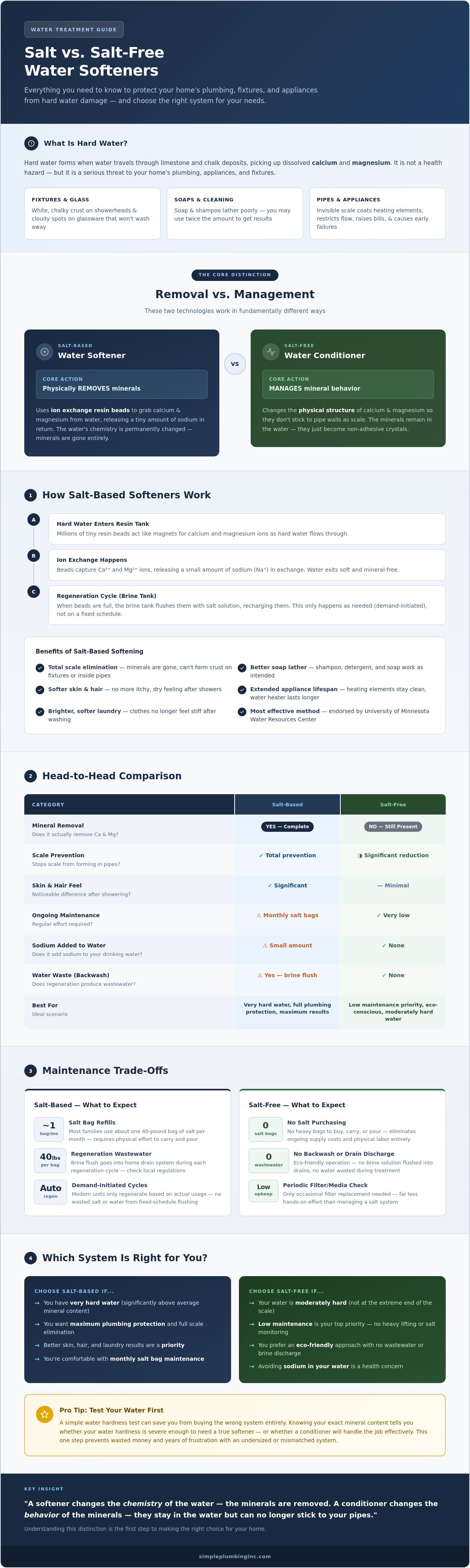
Salt vs. Salt-Free: A Side-by-Side Comparison
Choosing between a salt vs salt free water softener often comes down to your primary goal: do you want to change the water's chemistry or simply protect your pipes? Salt-based systems are the traditional heavyweights. They require more space because of the dual-tank design and need a nearby drain for the regeneration cycle. Salt-free systems are much more compact, often consisting of a single tank that doesn't need a drain or electricity. This makes them much easier to install in tight utility closets or older homes where adding a drain line would be a major project.
From a financial perspective, the trade-offs are clear. Salt-based units usually have a lower upfront equipment cost, but you'll spend money every month on salt bags and slightly higher water bills due to the flush cycle. Salt-free units cost more at the start but have almost zero monthly operating costs. When looking for effective hard water solutions in Yucaipa CA, you also have to consider local environmental factors. California has strict regulations regarding brine discharge in certain districts, so a salt-free system is often the more "neighborly" choice for the local ecosystem.
Comparing Performance on Scale Prevention
Both systems do a good job of protecting your plumbing, but they aren't equal. If your main concern is your water heater lifespan, you should know that salt-based systems offer the highest level of protection. Template Assisted Crystallization (TAC) used in salt-free systems is roughly 90-95% effective at preventing scale, while traditional ion exchange is nearly 99% effective. For most homeowners, that 5% difference isn't noticeable, but in areas with extreme mineral content, that small gap can lead to minor buildup over a decade or more.
Maintenance and Ease of Use
The maintenance schedules for these two systems look very different. With a salt-based system, you are on a monthly clock. You have to check the brine tank, haul heavy 40-pound bags from the store, and ensure no salt bridges have formed. It's a manageable task, but it is a recurring chore. Salt-free systems are the definition of "set it and forget it." There are no monthly tasks at all. You simply have a professional replace the internal media every 3 to 5 years. If you want to spend less time in your utility room and more time enjoying your home, the salt-free path is hard to beat.
If you're ready to stop the scale and protect your plumbing, we can help you install a new water softener that fits your budget and your lifestyle.
Making the Right Choice for Your Home and Budget
The decision between a salt vs salt free water softener shouldn't be a guessing game. It starts with a professional water hardness test. Without knowing the exact mineral count in your water, you might choose a system that doesn't solve your specific problems. We believe in being straight shooters with our Yucaipa neighbors. That means we look at your test results and your home's layout before making a recommendation. We want you to have a solution that works on day one and continues working ten years from now.
Professional installation is the final piece of the puzzle. Whether you choose a salt-based or salt-free system, it must be integrated correctly into your main water line. A pro ensures the bypass valves are accessible and the settings match your family's water usage patterns. This prevents common issues like pressure drops or incorrect regeneration cycles. Our approach at Simple Plumbing Inc is built on transparency and calm competence, making sure the process is easy to understand from start to finish.
When to Choose a Salt-Based Softener
- Choose this if you want the "luxury" feel of truly soft water that makes skin and hair feel smoother.
- This is the best option if your water hardness is high, typically above 10 or 15 grains per gallon.
- Go with salt-based if you want to stop using rinse aids in your dishwasher and see perfectly clear glassware every time.
When a Salt-Free Conditioner Makes Sense
- Choose this if you are on a sodium-restricted diet or prefer not to have any added sodium in your water.
- This is a great fit for homes with limited utility space since it doesn't require a bulky brine tank.
- Pick a conditioner if you want to protect your appliances from scale without the monthly chore of hauling salt bags.
The Next Steps for Your Plumbing Health
Protecting your home's plumbing is a long-term investment. If you are tired of scrubbing crusty buildup or worrying about your pipes, it is time for a professional assessment. We can help you look at your water softener installation in Yucaipa options and find a path that fits your budget. Every home is different, and we take the time to explain which technology will actually deliver the results you expect. Contact Simple Plumbing Inc for a straightforward assessment of your home's water.
Take Control of Your Home’s Water Quality
Choosing between a salt vs salt free water softener doesn't have to be a source of stress. You now understand that salt-based systems offer total mineral removal for that luxury feel, while salt-free conditioners provide a low-maintenance shield for your appliances. The best choice depends entirely on your home's specific mineral levels and your family's daily priorities. Whether you want the complete elimination of scale or a set-it-and-forget-it solution, there is a path that fits your budget.
As a veteran-owned and operated business, we pride ourselves on providing transparent, no-pressure plumbing advice. We live and work right here in Yucaipa, so we understand the local water challenges better than anyone else. Our goal is to give you honest answers so you can make a decision with total confidence. Don't let hard water minerals continue to damage your fixtures or shorten the life of your appliances. We invite you to Schedule a Water Quality Assessment with Simple Plumbing Inc today. We'll give you a straightforward look at your water and help you find the most reliable solution for your home.
Frequently Asked Questions
Does a salt-free water softener actually soften the water?
No, a salt-free system does not technically soften water because it doesn't remove minerals. Instead, it "conditions" the water by changing the mineral structure so they don't stick to your pipes. If you want the actual removal of calcium and magnesium, a salt-based unit is the only way to achieve true softness. Conditioning is about scale prevention, not changing the water's chemical hardness.
Is salt-based water softener water safe to drink?
Yes, water treated by a salt-based system is generally safe to drink for healthy individuals. The process adds a small amount of sodium, not actual salt, to the water. If you're on a strictly sodium-restricted diet, you might consider installing a reverse osmosis system at your kitchen tap or consulting with your doctor first. For most families, the sodium increase is negligible compared to a normal diet.
How often do I need to add salt to a traditional softener?
Most homeowners need to add a 40-pound bag of salt to their brine tank about once a month. Your specific schedule depends on how much water your family uses and how hard your local water is. It's a good habit to check the salt level every few weeks to ensure the system has enough to regenerate properly. Keeping the tank at least half-full ensures consistent performance.
Will a salt-free system stop the white spots on my dishes?
No, a salt-free system won't eliminate spots on your glassware because the minerals are still present in the water. Since the calcium and magnesium aren't physically removed, they will leave a residue behind once the water evaporates. When comparing a salt vs salt free water softener, the salt-based option is the only one that truly solves the spotting problem by clearing the minerals out entirely.
Which system is better for the environment?
Salt-free systems are generally considered the more environmentally friendly choice. They don't require electricity and don't produce a salty brine discharge that flows into local sewer systems. This makes them a popular option in areas with strict wastewater regulations or for homeowners who want to minimize their chemical footprint. They also use less water because they don't require a backwash or regeneration cycle.
Can a salt-free conditioner damage my plumbing?
No, a salt-free conditioner will not damage your plumbing; in fact, it's designed to protect it. By preventing minerals from bonding to your pipes and heating elements, it helps maintain water pressure and extends the life of your appliances. It's a safe and effective way to manage scale without changing the chemical makeup of your water. It simply keeps the minerals moving through the system instead of settling.
Do I need a plumber to install a water softener?
Yes, we strongly recommend having a professional plumber handle the installation to ensure everything is up to code. A plumber can properly size the unit for your home's needs and ensure the drain and bypass valves are installed correctly. This prevents leaks and ensures your system operates at peak efficiency from the very first day. Professional setup also protects your manufacturer's warranty and prevents accidental water damage.
How much space does a salt-based water softener require?
A traditional salt-based system requires a fair amount of room because it usually uses two separate tanks. You'll need enough floor space for the tall resin tank and the wider brine tank, which often takes up about three to four square feet total. When deciding between a salt vs salt free water softener, remember that conditioners are much more compact and better for tight utility closets or small garages.


