
Picture hosting dinner on a warm evening, only for the grill flame to die out on half-cooked steaks because your propane tank ran dry. Swapping heavy tanks mid-barbecue is frustrating, and worrying whether an underground pipe might leak or corrode brings its own stress. When planning an outdoor gas line installation for grill Yucaipa backyards require, you want dependable fuel, protected landscaping, and complete safety for your household.
You shouldn't have to decipher confusing trench depth rules, California plumbing codes, or gas meter sizing charts on your own. You just want a clear, honest path to an outdoor setup that works every time you turn the burner knob. In this guide, you will discover how to plan, size, and safely install a dedicated outdoor gas line for your grill in Yucaipa. We will walk through local permitting steps, proper burial depths, and how to ensure your gas meter has the capacity to support your barbecue for years to come.
Key Takeaways
- Confirm whether your barbecue requires a natural gas conversion kit and calculate its total BTU demand to ensure adequate flame power.
- Select California-approved underground pipe materials and maintain required burial depths to protect the line from future landscaping work.
- Navigate your outdoor gas line installation for grill Yucaipa permits smoothly while checking that your SoCalGas meter can support the extra fuel load.
- Work with a licensed C-36 plumbing specialist who handles precision pressure testing and adheres to local safety inspections.
- Learn what to expect during the installation process so your turf, garden beds, and existing utilities stay protected from start to finish.
Evaluating Your Grill’s Gas Requirements and Fuel Source in Yucaipa
Planning an outdoor gas line installation for grill Yucaipa projects starts with understanding fuel delivery. You can't simply hook an existing propane grill to a utility supply line and expect clean combustion. Both fuel chemistry and volume demand precise planning before breaking ground.
Natural Gas Line Conversion vs. Liquid Propane
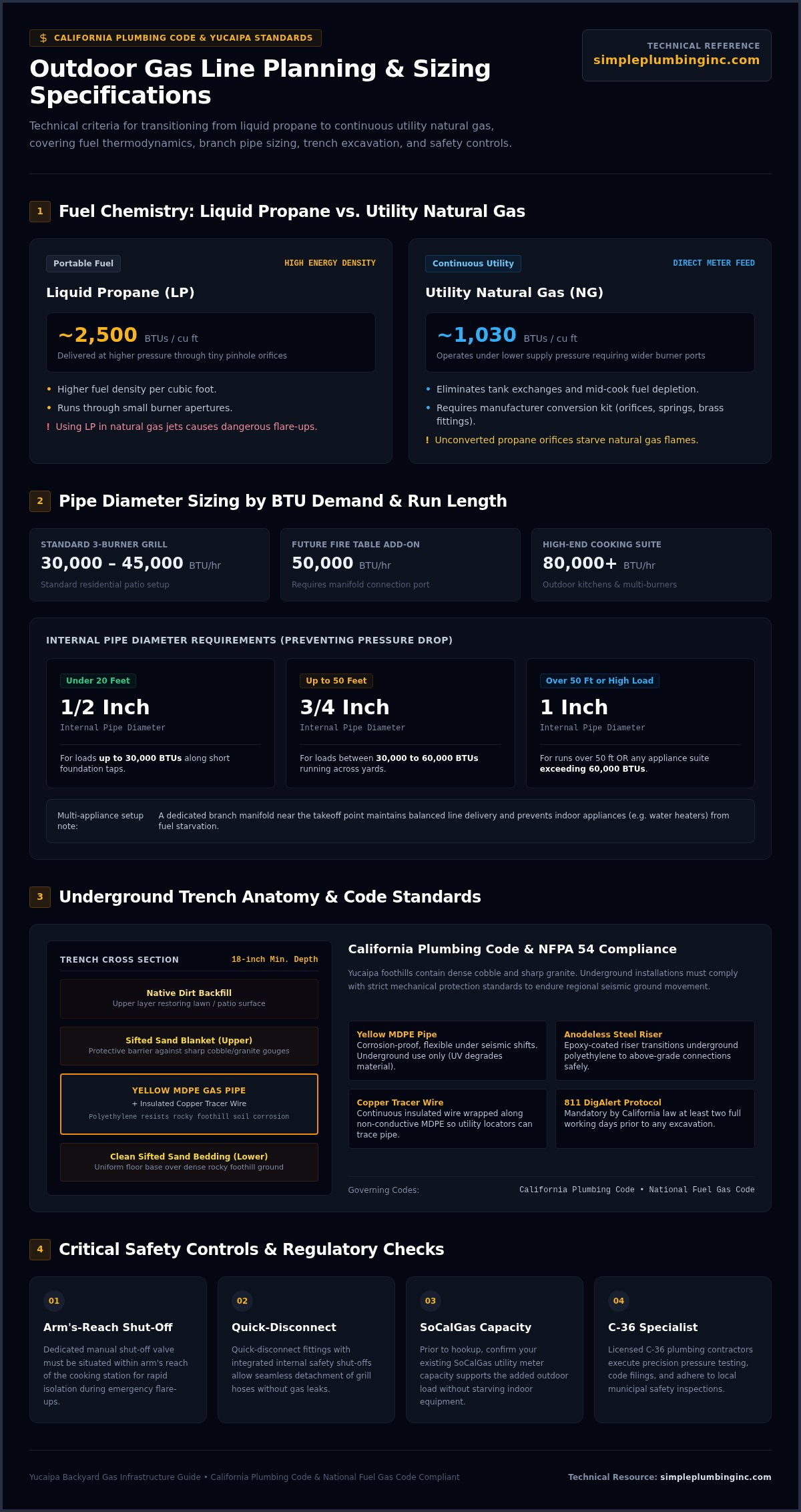
Liquid propane delivers roughly 2,500 BTUs per cubic foot, while natural gas provides about 1,030 BTUs. Because propane is denser and delivered at higher pressure, propane orifices have tiny pinholes. Natural gas requires wider openings and different regulator pressures to deliver equivalent heat. Using propane fittings with natural gas starves your flame, while running propane through natural gas jets creates hazardous flare-ups.
If your grill came set up for propane, you must install a manufacturer-approved conversion kit with dedicated orifices, springs, and brass fittings. This switch ties your barbecue directly into utility fuel. Much like regional pipeline transport systems that move fuel safely under controlled conditions, your home setup depends on balanced line pressure to operate properly.
Calculating Appliance BTUs and Pipe Diameters
Every grill carries a data plate displaying its total British Thermal Units (BTU) rating. A standard three-burner grill often consumes 30,000 to 45,000 BTUs per hour, while high-end outdoor cooking suites easily exceed 80,000 BTUs.
Distance matters just as much as fuel volume. As natural gas travels through piping, internal friction causes pressure drops. Running a line 60 feet across your yard requires a larger pipe diameter than a short 15-foot tap along the patio foundation:
- Up to 30,000 BTUs (under 20 feet): 1/2-inch internal pipe diameter
- 30,000 to 60,000 BTUs (up to 50 feet): 3/4-inch internal pipe diameter
- 60,000+ BTUs or runs over 50 feet: 1-inch internal pipe diameter
Accounting for Additional Outdoor Gas Appliances
Backyard kitchens often expand over time. If you plan to add a 50,000 BTU fire table or a side burner later, calculate that total demand today. Starving your branch line causes weak, flickering flames and can pull fuel away from indoor essentials like your water heater.
A dedicated branch manifold installed near your takeoff point balances delivery across separate runs. It gives you capped connection ports for future projects, ensuring that an outdoor gas line installation for grill Yucaipa homeowners invest in provides consistent heat across every burner.
Selecting Pipe Materials and Meeting Yucaipa Trenching Standards
Trenching and pipe selection require careful attention to local ground conditions. Yucaipa sits in the foothills, where rocky soil and regional seismic activity make material durability essential for a secure outdoor gas line installation for grill Yucaipa setups.
Underground Pipe Materials: Polyethylene vs. Coated Steel
Yellow medium-density polyethylene (MDPE) pipe is the benchmark for underground runs. Unlike standard black iron, which rusts quickly when exposed to moisture and minerals in foothill dirt, polyethylene resists corrosion completely and flexes during subtle ground shifts. Polyethylene pipe cannot run above ground because ultraviolet sunlight degrades the material. It connects below ground to an epoxy-coated anodeless steel riser that brings the fuel above grade. Since plastic pipe isn't conductive, installers wrap a continuous, insulated copper tracer wire along the pipe so future locators can easily trace its path.
Trench Depth and Soil Bedding Requirements
Under the California Plumbing Code and the National Fuel Gas Code, underground yard lines must rest at least 18 inches below the finished grade. Digging in Yucaipa often uncovers sharp granite and dense cobble that can gouge buried pipe during backfilling. To protect the pipe, the trench floor should receive a clean bed of sifted sand before laying the line, followed by another protective sand blanket above it before backfilling with native dirt. Calling 811 DigAlert at least two full working days before excavation is required by law to identify existing buried utilities.
Safety Valves, Quick-Disconnects, and Regulators
Every grill hookup requires a dedicated manual shut-off valve located within arm's reach of the cooking station. This setup lets you cut the fuel supply immediately during an emergency or when heading out of town. Quick-disconnect fittings with internal safety shut-offs make it simple to detach the grill hose and move the cart when washing patio slabs. Finally, a dedicated low-pressure regulator ensures your burners receive steady delivery pressure without wind-blown flame fluctuations. If you'd like your yard evaluated for safe trench pathways and code-compliant routing, the team at Simple Plumbing Inc can map out your layout from meter to patio with precision.
Navigating Yucaipa Permits, Inspections, and SoCalGas Capacity
Safe outdoor fuel lines rely on municipal oversight and proper utility sizing. Skipping either step risks safety hazards, home insurance complications, and poor flame performance on your barbecue. Knowing local city guidelines makes the outdoor gas line installation for grill Yucaipa backyards require straightforward and predictable.
City of Yucaipa Building and Safety Permit Requirements
The City of Yucaipa requires an official plumbing permit for adding or extending fuel gas lines. Applications go through the city's digital portal, the Yucaipa Permit Exchange, managed by the Community Development Department. Pulling this permit creates an official record of the work. If an unpermitted gas installation ever leads to fire or property damage, insurance adjusters can deny claims outright. A formal permit also guarantees that an independent city inspector confirms the line meets current California Plumbing Code standards before you bury it.
Assessing SoCalGas Meter and Service Line Capacity
Southern California Gas Company owns and services the gas supply line up to the meter. Everything downstream from that meter is the property owner's responsibility. Every SoCalGas meter features a metal faceplate stamped with a capacity rating in cubic feet per hour (CFH), where one CFH roughly equals 1,000 BTUs.
Your meter must deliver sufficient volume when multiple gas appliances run at once. You must tally your home's total connected load, factoring in recent upgrades like a water heater replacement in Yucaipa alongside your central furnace, cooktop, and clothes dryer. If adding your barbecue pushes total demand past your meter's stamped rating, you must submit a Connected Load Form to SoCalGas to upsize the meter before running the grill.
The Pressure Test: Verifying Zero Gas Leaks
Before closing the trench, the contractor must run a formal air pressure test. The gas supply remains shut off, and the new pipe run is pumped full of compressed air using a calibrated diaphragm pressure gauge.
City of Yucaipa inspectors check this gauge on-site to verify the system holds steady pressure over a designated testing period without dropping. Even a microscopic decrease indicates a fitting joint leak that must be resolved. Professional plumbers use pinpoint leak detection in Yucaipa CA methods to seal every connection bubble-tight, providing signed inspection sign-offs and total safety before backfilling the trench.
Choosing the Right Contractor for Outdoor Gas Lines in Yucaipa
Piping natural gas across your yard requires specialized skills and dedicated safety equipment. It is not work for an unlicensed handyman. When scheduling an outdoor gas line installation for grill Yucaipa backyards, picking a qualified contractor ensures your system remains leak-free and built to code.
Verifying California C-36 Licensing and Insurance
California law mandates a C-36 plumbing license for any contractor working on fuel gas distribution lines. You can check a contractor's status in seconds using the Contractors State License Board (CSLB) online portal. Look for an active license in good standing, valid workers' compensation coverage, and substantial general liability insurance.
Unlicensed workers often offer cut-rate services by skipping city permits and pressure testing. If an unpermitted gas leak triggers an accident, your homeowner insurance policy may refuse to cover the damages.
Evaluating Scope of Work: Trenching vs. Plumber-Only Scopes
Plumbing estimates can vary widely based on what each company includes. Some contractors only glue pipe and expect you to excavate the ditch yourself. A complete outdoor gas line installation for grill Yucaipa homeowners invest in should cover the entire job under one clear agreement:
- Excavation and backfill: Digging down 18 inches through rocky foothill soil and bedding the trench with clean sand.
- Administrative handling: Submitting paperwork to the Yucaipa Permit Exchange and attending the physical inspector walk-through.
- Connection and calibration: Installing the emergency shut-off valve, attaching the flex line, and fine-tuning the grill burners.
The Value of Veteran-Owned Integrity and Communication
Working with fuel gas leaves zero room for guesswork. A company built on U.S. Marine Corps discipline approaches every fitting with methodical precision. You get clear timelines, straight answers, and an honest evaluation of what your property actually requires. Local Yucaipa specialists have a personal stake in keeping their neighbors safe, delivering reliable work without high-pressure sales pitches or surprise charges.
If you are ready to retire your propane tanks for good, contact Simple Plumbing Inc to schedule an outdoor gas line consultation today.
What to Expect During a Professional Gas Line Installation
Adding a permanent fuel line shouldn't feel chaotic or mysterious. When you know each phase of the project in advance, you can prepare your yard and plan your outdoor cooking schedule with confidence. A proper outdoor gas line installation for grill Yucaipa backyards follows a methodical, step-by-step process designed to protect your property and ensure absolute safety.
Initial Site Evaluation and Route Planning
The job starts with a thorough physical walkthrough. Your plumber evaluates your gas meter location, assesses soil grade, and tracks the shortest route to your barbecue station. If you are building a new patio kitchen from scratch, integrating the fuel line during new construction plumbing in Yucaipa keeps the piping safely concealed beneath future masonry or concrete flatwork. Once the route is clear, DigAlert markings are confirmed on-site so excavation avoids sprinkler manifolds, electrical conduits, or water mains.
Pipe Placement, Backfill, and Safety Testing
Crews dig the 18-inch trench carefully, taking special care around tree roots and established garden beds. Once the trench floor is cleared and cushioned with sand, the yellow polyethylene pipe and its tracer wire go into place. Before any dirt goes back in, the system is sealed and pressurized with air for the official municipal inspection. After the city inspector signs off on the pressure gauge, workers backfill the trench in compacted layers, leaving your lawn and flowerbeds tidy and level.
Final Connection, Meter Activation, and Burner Tuning
With the trench closed, the plumber connects the riser to your house gas supply and installs a dedicated emergency shut-off valve near your grill cart. Technicians then purge trapped air from the line before attaching the quick-disconnect flex hose. Finally, the burners are lit to check manifold pressure and flame characteristics. A healthy flame burns steady and blue with tiny yellow tips, confirming clean fuel combustion and balanced delivery. Ready to upgrade your outdoor kitchen? Contact Simple Plumbing Inc today.
Bring Reliable Fuel to Your Backyard Kitchen
Upgrading from swappable propane tanks to a dedicated utility line changes how you enjoy your backyard. Getting the project right comes down to precise BTU calculations, selecting corrosion-proof underground materials, and verifying that every joint passes city pressure tests before the trench closes. When your fuel system is planned properly, you get steady heat for every cookout without second-guessing safety.
Executing an outdoor gas line installation for grill Yucaipa properties requires strict attention to detail. Simple Plumbing Inc brings veteran-owned Marine Corps precision to every project. Our technicians know local Yucaipa building codes inside and out, handling everything from permit coordination and trench routing to advanced pressure testing. If you are ready to enjoy endless fuel for your barbecue, schedule your outdoor gas line consultation with Simple Plumbing Inc today and fire up your grill with complete peace of mind.
Frequently Asked Questions
Can I install my own outdoor gas line for a grill in Yucaipa?
No, working on combustible fuel lines without professional training poses severe safety risks. While California law allows certain owner-builder permits, running exterior gas piping requires specialized pressure gauges, pipe fusion tools, and strict code knowledge. Unlicensed DIY work can void homeowner insurance policies and fail city inspections. Hiring a licensed C-36 plumbing contractor ensures the line is sized correctly, pressure-tested, and fully compliant with municipal safety codes.
What is the required trench depth for an underground gas line in Yucaipa?
Underground gas piping in Yucaipa must be buried at least 18 inches below finished grade under the California Plumbing Code. This depth protects the line from lawn aerators, shovel strikes, and surface traffic. Because Yucaipa soil contains dense cobble and rocks, installers lay the yellow polyethylene pipe over a bed of clean sand. Another layer of sand covers the line before backfilling native soil to prevent sharp rocks from crushing the pipe.
Will my existing gas meter support an outdoor grill and fire pit?
It depends on your meter's total cubic feet per hour (CFH) rating and the combined fuel demand of your indoor appliances. A standard residential meter often handles 250 CFH. If your water heater, furnace, and range run at peak demand, adding an 80,000 BTU grill and fire pit might exceed that capacity. A plumber calculates your connected load and submits paperwork to SoCalGas for a meter upsize if your system needs higher volume.
Can any standard propane grill be hooked up to a natural gas line?
Not without an official manufacturer conversion kit designed specifically for your model. Propane and natural gas burn under different pressures and fuel-to-air ratios. Propane orifices have narrow pinholes, while natural gas requires larger apertures to produce equivalent heat. Hooking a propane grill directly to utility gas results in dangerously weak flames. Many popular grill brands sell factory conversion kits with properly calibrated brass jets, regulator springs, and quick-disconnect fittings.
How long does a typical outdoor gas line installation take to complete?
A standard outdoor gas line installation for grill Yucaipa backyards typically takes one to two business days to complete. Day one involves trench excavation, laying sand bedding, running poly pipe, and setting the pressure gauge. Once the system holds test pressure, the City of Yucaipa conducts its physical inspection. After the inspector signs off, technicians backfill the trench, connect the final appliance valves, and test your grill burners for clean combustion.
Do I need a city permit to run a gas line to my backyard patio?
Yes, the City of Yucaipa requires an approved plumbing permit for running or modifying any gas fuel line. Applications go through the city's online Permit Exchange before excavation begins. Skipping a permit creates liability issues and risks insurance claim denials if an uninspected line leaks. A licensed plumber pulls the permit on your behalf, coordinates the mandatory air pressure inspection, and makes sure your setup passes building division standards.


